State PSC Form Guide: UPPSC, BPSC, MPPSC, and RPSC Mistakes to Avoid
State PSC application guide with practical checks for domicile, language options, reservation certificates, and correction window usage.
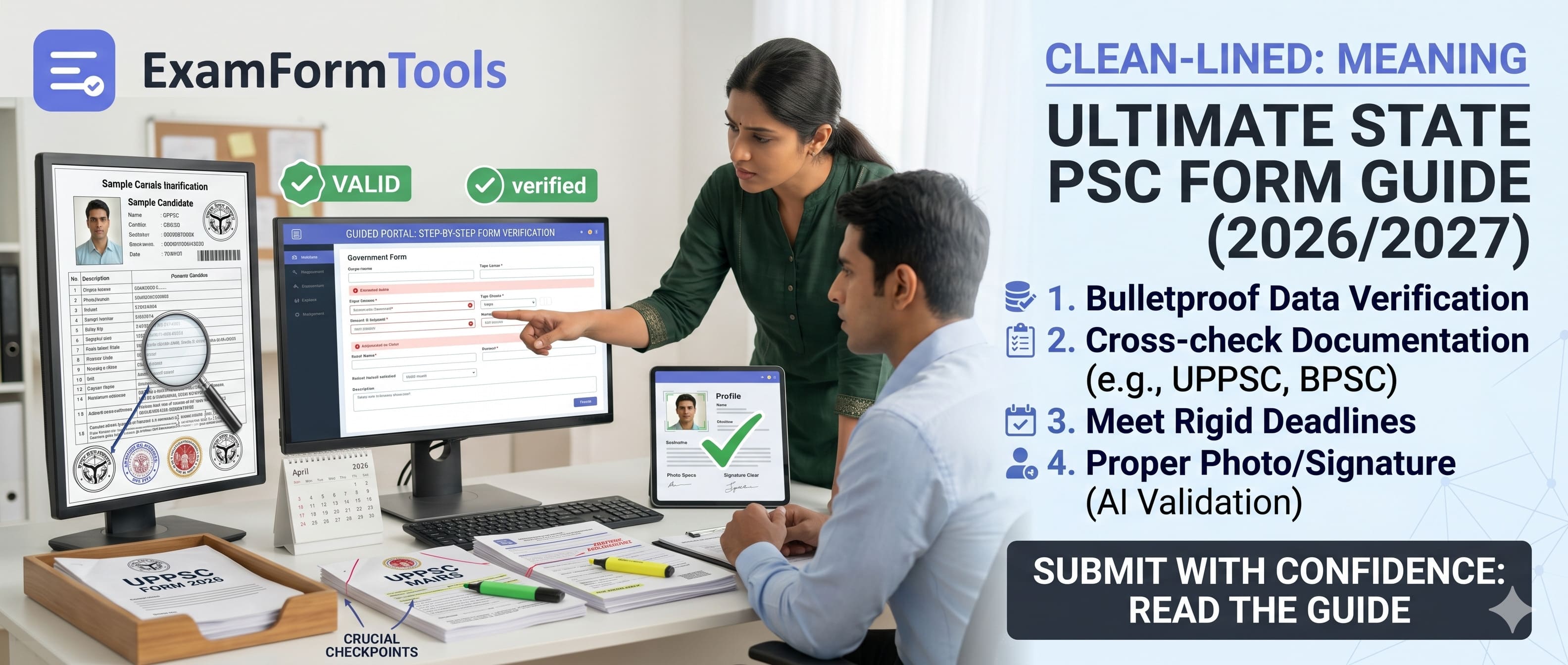
State PSC forms are more variable than most aspirants expect. Fields, document formats, and reservation conditions can differ sharply by commission. I learned this the hard way back in 2022 when I assumed that my UPPSC form experience would translate smoothly to BPSC. Spoiler alert: it didn’t. What worked perfectly for one exam got flagged in another, and I spent three panicked days during the correction window fixing issues I didn’t even know existed.
The truth is, each State PSC has evolved its own ecosystem of rules, formats, and quirks. Some of these differences are logical. Others? Well, let’s just say they’re “historically developed preferences” that make little sense to anyone outside the commission office. But here’s the thing: understanding these variations isn’t just helpful, it’s absolutely essential if you want your application to sail through without hiccups.
Why State PSC Forms Feel Tricky (And Sometimes Downright Confusing)
When you’re preparing for competitive exams, you’re used to finding patterns. Math has formulas. History has timelines. Even essay writing has structures. But State PSC application forms? They’re like a choose-your-own-adventure book where every commission wrote different chapters.
Let me paint you a picture. My friend Rahul applied to four different State PSCs in a single season—UPPSC, BPSC, MPPSC, and RPSC. Smart guy, dedicated preparation, everything organized. Or so he thought. Halfway through his third application, he noticed something strange. The domicile certificate format that UPPSC accepted without question was being flagged as “incomplete” by MPPSC’s portal. The language preference option that seemed straightforward in BPSC turned into a complex decision tree in RPSC. By the fourth form, he was second-guessing everything.
Here are the common differences that trip people up:
Domicile format and district-level details: Some commissions want your domicile certificate issued within the last three years. Others accept certificates that are five or even ten years old, as long as they’re from the correct authority. UPPSC might ask for your tehsil and district in separate fields, while BPSC combines them. RPSC sometimes requires additional proof of continuous residence, which nobody tells you about until you’re staring at an error message.
Language paper selection rules: This one’s a minefield. In UPPSC, you might have the flexibility to choose Hindi, English, or both for certain papers. BPSC could have a mandatory Hindi paper regardless of your preference. MPPSC might let you attempt questions in either language but require you to declare your choice upfront. And RPSC? They’ve been known to have specific marking schemes that vary based on language selection. Missing this detail could literally change your strategy.
Reservation sub-category options: The general categories are usually consistent—General, OBC, SC, ST. But the sub-categories? That’s where things get wild. One commission might have separate options for OBC-NCL (Non-Creamy Layer) with specific income threshold requirements. Another might split SC into multiple sub-groups. A third might have special provisions for EWS (Economically Weaker Sections) with completely different documentation requirements.
Additional declaration documents: Some PSCs require additional affidavits about criminal records, government employment status, or educational qualifications. Others bundle these into a single declaration. The formats, notary requirements, and submission deadlines vary significantly. I’ve seen cases where candidates prepared a perfect set of documents for one PSC, only to discover that another PSC needed completely different attestation levels.
The golden rule? Never, ever assume rules from one PSC apply to another. Even if two commissions are neighbors geographically, their forms might be worlds apart in requirements.
Build State-Specific Document Folders (Your Future Self Will Thank You)
Organization sounds boring, I know. When you’re juggling syllabus revision, current affairs, and practice tests, creating folders feels like administrative busywork. But trust me on this one—a good folder structure has saved more applications than any last-minute correction attempt ever could.
I recommend creating separate folders for each commission application. Not just on your computer, but also in your cloud storage and, ideally, a physical backup for critical documents. Yes, I’m that paranoid. But I’m also that person who’s never lost an important certificate at 11 PM before a form deadline.
Here’s my suggested structure, refined through multiple application cycles:
ExamApplications_2026/
├── UPPSC_PCS_2026/
│   ├── Photos/
│   ├── Signature/
│   ├── Certificates/
│   ├── Payment_Proofs/
│   └── Final_Submitted_Forms/
├── BPSC_CCE_2026/
│   ├── Photos/
│   ├── Signature/
│   ├── Certificates/
│   ├── Payment_Proofs/
│   └── Final_Submitted_Forms/
├── MPPSC_State_Service_2026/
│   ├── Photos/
│   ├── Signature/
│   ├── Certificates/
│   ├── Payment_Proofs/
│   └── Final_Submitted_Forms/
└── RPSC_RAS_2026/
    ├── Photos/
    ├── Signature/
    ├── Certificates/
    ├── Payment_Proofs/
    └── Final_Submitted_Forms/
Why so specific? Because each commission might have different photo specifications. UPPSC might want 3.5 cm × 4.5 cm with 70% face coverage. BPSC could ask for 4 cm × 5 cm with specific background colors. If you try to use the same photo file for everything, you’ll end up with rejections or quality issues.
The same goes for signatures. Some portals need vector signatures under 20 KB. Others accept larger files but require specific DPI settings. Keeping commission-specific versions means you’re not scrambling to recreate files during correction windows.
Here’s a practical tip: label your files with dates and version numbers. Instead of “domicile.pdf,” use “domicile_issued_2024-01-15_v1.pdf.” When you need to upload an updated version, you’ll know exactly which one is current. I once saw someone upload their old domicile certificate instead of the renewed one because both files were named “domicile.pdf.” The correction window had closed before they caught the mistake.
Domicile and Language Pitfalls (Where Good Applications Go to Die)
Let me tell you about Priya’s experience. Bright student, top 3% in her coaching institute, impeccable preparation. She filled out her UPPSC form with the domicile certificate her family had used for years—valid, properly attested, issued by the right authority. Everything looked perfect.
Until it wasn’t.
Turns out, the certificate was issued in 2018, and UPPSC’s 2025 notification specifically required domicile certificates issued within the last 36 months for first-time applicants. The notification buried this detail in paragraph 4, sub-clause (iii), using language that required a law degree to parse. Priya’s application got flagged during document verification, months after she’d already started preparation for mains.
The lesson? Domicile and language requirements are the silent killers of PSC applications. They seem straightforward until they absolutely aren’t.
Common domicile mistakes I’ve seen (and sometimes made):
Using outdated domicile certificates: Different commissions have different validity requirements. Some want certificates issued within three years, others within five. A few don’t specify, which doesn’t mean they’ll accept anything—it means they evaluate on a case-by-case basis, and you don’t want to be that case. Always check the notification’s fine print. If you’re unsure, get a fresh certificate. The hassle now beats the heartbreak later.
District-level mismatches: This one’s sneaky. Your domicile certificate might list your district using the old administrative name, but the application portal dropdown uses the new name after a recent reorganization. Or vice versa. I’ve seen candidates from Uttarakhand struggle with this when districts were re-divided. The solution? Cross-reference your certificate against the portal’s exact terminology before entering data.
Tehsil and block confusion: Some forms want your tehsil, others want your block, and a few want both without clearly explaining the difference. If your area has multiple administrative divisions, make absolutely sure you’re selecting the right one. Verification officers will check this against your certificate, and mismatches mean rejections.
Language selection pitfalls (because nothing’s ever simple):
Accidentally selecting the wrong medium: Some portals have radio buttons for language selection positioned right next to each other. One misclick during a late-night form session, and you’ve committed to attempting a paper in a language you’re not comfortable with. I knew someone who selected Urdu instead of Hindi because the buttons were similar. They didn’t notice until the admit card arrived. The correction window? Already closed.
Not understanding medium versus question language: Certain PSCs allow questions to be printed in multiple languages, but you have to declare which one you’ll primarily use. This affects how your answers are evaluated, especially in descriptive papers. Choosing the wrong one doesn’t just create convenience issues—it can actually impact scoring if evaluators are assigned based on declared language preference.
Ignoring language paper implications for mains: Some prelims applications ask about your optional language preference for mains. It seems premature, but the choice can lock you in. If you casually select Sanskrit because it’s your graduation medium, you might find yourself committed to a Sanskrit paper in mains even if you’re rustier than you thought.
Reservation certificate format issues (the bureaucratic maze):
State governments update reservation certificate formats periodically. BPSC might accept certificates in the old format if issued before a certain date, but require the new format for recent issues. MPPSC could mandate specific clauses to be mentioned in the certificate itself. RPSC sometimes cross-verifies certificates with issuing authorities, so any formatting deviation becomes a red flag.
The safe approach? Before filling any form, download the latest certificate format from the commission’s website. Compare it with what you have. If there are any differences—even minor ones like header formatting or attestation location—get a new certificate in the current format. Yes, it means another trip to the tahsil office. Yes, it’s worth it.
Correction Window Usage (Your Second Chance, Not a Redo Button)
The correction window is both a blessing and a trap. It’s a blessing because commissions recognize that people make mistakes, and fixing them shouldn’t mean disqualification. It’s a trap because people misuse it, making hasty changes that create new problems.
When the correction window opens, you might feel pressure to review every single field again. Resist this urge. Correction windows are for fixing actual errors, not for second-guessing decisions you made correctly the first time.
Priority-based correction approach:
Fix identity and eligibility fields first: Name spellings, date of birth, parent names, category selection—these are the fields that get verified against official documents. If there’s any mismatch, fix it immediately. I’ve seen applications rejected in the final stages because someone’s name was “Rahul Kumar” on their form but “Rahul Kr.” on their certificate. The difference seems trivial, but verification systems are literal-minded.
Re-upload unclear files second: If your uploaded photo is blurry, signature is pixelated, or certificates are barely readable, use the correction window to upload better versions. But—and this is important—don’t change the actual documents themselves. If you uploaded your 10th marksheet, upload a clearer scan of the same marksheet, not a different document. Inconsistencies raise red flags.
Save screenshot evidence of final corrected details: Here’s something most people don’t do but absolutely should. After making corrections and before the window closes, take complete screenshots of every page of your application. Save them with timestamps. If any dispute arises later about what you submitted versus what the system recorded, you have proof. I’ve heard horror stories of candidates whose corrections somehow didn’t save properly, and they had no way to prove what they’d actually entered.
Things to avoid during correction windows:
Don’t make changes just because you can. Every edit is logged. If verification officers see that you changed your date of birth three times or switched categories twice, it looks suspicious even if all changes were genuine corrections.
Don’t wait until the last day. Correction window servers often crash in the final hours when thousands of candidates log in simultaneously. Make your changes early, then verify them a day before closing.
Don’t use the correction window to update documents that don’t need updating. If your original domicile certificate was fine, don’t upload a new one just because you got it reissued. Unnecessary changes create unnecessary verification confusion.
Unified PSC Final Checklist (The Pre-Submission Ritual)
I have a friend who treats form submission day like an exam day. He wakes up early, has a light breakfast, and sits down with printed checklists. Excessive? Maybe. Effective? Absolutely. He’s never had an application rejected for form errors in seven years of attempting various PSCs.
Here’s a comprehensive checklist that combines his paranoia with my hard-earned lessons:
Personal details verification:
- Name matches certificates exactly (including middle name, surname formatting)
- Date of birth is in DD-MM-YYYY format as required
- Gender selection is correct (yes, people make mistakes here)
- Father’s and mother’s names match school certificates
- Current and permanent addresses are complete with PIN codes
- Email ID and mobile number are active and belong to you (not shared/temporary)
Category and domicile verification:
- Category selected matches your current valid certificate
- Sub-category (if applicable) is chosen correctly
- Domicile certificate is recent enough per notification requirements
- District, tehsil, and block information matches certificate exactly
- EWS/Creamy Layer declarations (if required) are correctly filled
- Certificate numbers and issue dates are accurate
Educational qualification details:
- Degree names match exactly as printed on certificates
- University/Board names are from dropdown or entered correctly
- Percentage/CGPA calculation follows commission guidelines
- Year of passing is accurate
- Roll numbers and registration numbers (if asked) are correct
- Optional subjects for graduation match mark sheets
Language and preference selections:
- Medium of examination is intentionally chosen, not accidentally clicked
- Optional subject (if applicable) is finalized after genuine consideration
- Center preferences are in actual priority order
- Any special requirements (scribe, extra time) are marked correctly
Document upload verification:
- Photo meets exact dimension, size, and background requirements
- Signature is clear, on white background, and within size limits
- All certificates are in specified format (usually PDF or JPG)
- File sizes are within limits (usually 20-100 KB per file)
- Documents are legible when downloaded and viewed
- File names don’t contain special characters
Final submission checks:
- Complete preview done page by page
- Final PDF downloaded and stored safely
- Payment successful and transaction ID saved
- Confirmation email received (check spam folder too)
- Screenshot of complete submitted form taken
- Backup of all uploaded files maintained
Mistake Recovery Plan for PSC Applicants (When Things Go Wrong)
Mistakes happen. Sometimes it’s a typo. Sometimes it’s a wrong document. Sometimes it’s something you didn’t even know was wrong until someone pointed it out weeks later. The key is not to panic and certainly not to make impulsive decisions.
The 24-hour rule: If you discover an error right after submission, wait 24 hours before doing anything drastic. I know it’s hard. Your brain will scream at you to fix it immediately. But hasty actions during panic mode often make things worse.
Use those 24 hours to:
- Verify that it’s actually an error and not just anxiety talking
- Check if the error is material (affects eligibility) or cosmetic
- Read the notification again to understand correction window policies
- Gather all documents that might be needed for correction
Understanding correction window scope: Not all fields can be corrected. Some commissions allow corrections to uploaded documents but not to personal details. Others let you change almost everything except registration number and payment information. Read the correction window notification carefully. It usually specifies exactly what can and cannot be changed.
The systematic correction approach:
-
List errors in priority order: Critical errors that affect eligibility come first. These include wrong category, incorrect degree information, or invalid document uploads. Minor errors like preference order or address details come later.
-
Gather supporting documents before opening the form: Have all improved photos, clearer signatures, and correct certificates ready before you log in. Correction windows often have time limits per session. Fumbling around searching for files wastes precious time.
-
Update only necessary fields: This cannot be stressed enough. Touch only what needs fixing. The more fields you modify, the more chances you have of introducing new errors. I’ve seen people go in to fix a photo and accidentally change their date of birth while clicking around nervously.
-
Save before/after screenshots: Take screenshots before making any changes. Then make your corrections. Then take screenshots after saving. This creates a visual trail of what was wrong, what you fixed, and what the final version looks like. If there’s ever a discrepancy, you have evidence.
-
Verify immediately after the window closes: Once the correction window closes, most commissions allow you to view (not edit) your application. Log in and verify that all your changes are reflected correctly. Sometimes technical glitches cause saved changes to revert. Catching this immediately gives you time to contact helpdesk with screenshots as proof.
When you can’t fix it through the correction window:
Some errors can’t be fixed through portals. Maybe the correction window doesn’t open for your particular issue. Maybe you missed the correction window deadline (it happens, unfortunately). In such cases, your options are limited but not zero:
-
Helpdesk communication: Contact the official helpdesk with registered email. Explain the issue clearly, attach evidence, and request guidance. Be polite but persistent. Follow up if you don’t get a response in 48 hours.
-
Affidavit approach: For minor discrepancies (like name spelling variations), some commissions accept affidavits during document verification. Check if this option exists for your case. Get a notarized affidavit explaining the discrepancy and keep it ready for verification stage.
-
Direct commission contact: As a last resort, some candidates have successfully approached commission offices in person with documentary evidence. This isn’t guaranteed to work and definitely not convenient, but if your error is genuine and you have proof, it’s worth trying.
Multi-State Applicant Discipline (Playing Multiple Games Simultaneously)
Applying to multiple State PSCs in one season is like juggling while riding a bicycle. Possible? Yes. Easy? Definitely not. Rewarding if done well? Absolutely.
The candidates who succeed at multi-state applications aren’t necessarily the ones who are smartest or most prepared. They’re the ones who are most organized. They treat each application as a separate project with its own timeline, requirements, and quirks.
Commission-specific checklists: Don’t use a generic checklist for all PSCs. Each commission needs its own checklist reflecting its unique requirements. When I applied to three PSCs simultaneously, I created a spreadsheet with columns for each commission and rows for each requirement. Color coding helped me see at a glance what was done, what was pending, and what needed attention.
Distinct folder organization: We covered folder structure earlier, but it bears repeating for multi-state applicants. Keep everything separate. Not just main folders, but even within folders. Your UPPSC photo should be in a completely different location from your BPSC photo, even if they’re identical. Why? Because when you’re filling a form at midnight and need to upload a signature, you don’t want to accidentally grab the wrong file from a mixed folder.
Active deadline tracking: Create a master timeline that shows all critical dates for all commissions. Application start dates, end dates, payment deadlines, correction window periods, admit card releases, exam dates. Use a digital calendar with reminders, or a physical wall calendar, or both. The goal is to never be surprised by a deadline.
Weekly review ritual: Every Sunday (or whatever day works for you), spend 30 minutes reviewing your multi-state application status. What did you complete this week? What’s pending for next week? Are there any new notifications from any commission? This weekly check-in prevents things from falling through cracks.
Mental and physical separation: This might sound strange, but it helps. When you’re working on a UPPSC application, mentally commit to UPPSC mode. Use only UPPSC documentation, read only UPPSC notifications, follow only UPPSC guidelines. When you switch to BPSC, completely shift gears. This prevents the dangerous cross-contamination of requirements where you accidentally apply UPPSC rules to a BPSC form.
Communication log maintenance: Keep a record of all communications with all commissions. If you email MPPSC helpdesk about a query, save that email chain in your MPPSC folder with dates. If RPSC issues a clarification notification, save it. These records become invaluable when disputes arise or when you need to verify something during correction windows.
The Emotional Side of PSC Applications (Nobody Talks About This)
Here’s something that doesn’t appear in any official guide: PSC applications are emotionally draining. You’re not just filling forms. You’re committing to a path. You’re investing hope, money, time, and mental energy into a process that might take years.
Some days, you’ll feel confident. Other days, you’ll wonder if a single typo will ruin everything. Both feelings are normal.
What helps is separating your self-worth from your application. A mistake in a form doesn’t make you a failure. Getting confused by contradictory instructions doesn’t make you stupid. Missing a deadline is unfortunate, not a character flaw.
Build a support system. Find other PSC aspirants who understand the pressure. Join responsible online communities where people share genuine experiences, not just anxiety. Talk to people who’ve been through this process successfully—they’ll assure you that everyone struggles with these forms.
And remember this: commissions want you to apply correctly. Their jobs exist because candidates like you exist. These forms are meant to be filled successfully, not to trick you into making mistakes. Most commission employees genuinely want to help when you reach out with legitimate queries.
State PSC Success: The Long View
State PSC success starts with administrative precision, yes. But it’s also built on patience, self-awareness, and the wisdom to ask for help when you need it.
Every successful PSC officer has a story about their application journey. Some sailed through smoothly. Most didn’t. What separates them is not that they made fewer mistakes—it’s that they recovered from mistakes methodically, learned from errors without self-flagellation, and kept moving forward.
Your form execution does protect your preparation effort. All those hours of study, all that syllabus coverage, all those mock tests—they deserve a clean, correctly filled application. Give yourself the time and mental space to do this part well.
And when you finally see that admit card in your email, with your photo, your details, everything correct and verified, you’ll feel a satisfaction that goes beyond the exam itself. You navigated a complex bureaucratic process successfully. That’s a skill that will serve you long after you’ve forgotten the intricacies of PSC forms.
State PSC applications are challenging, but they’re absolutely manageable with the right approach. Take them seriously, but don’t let them intimidate you. You’ve got this.