CBSE Class 12 Result 2026 - Next Steps: College Admissions, Merit Lists, Cutoff Scores & Counseling
Complete guide to CBSE Class 12 result-to-college admission journey. Understand merit lists, cutoff scores, counseling process, and make informed college choices.
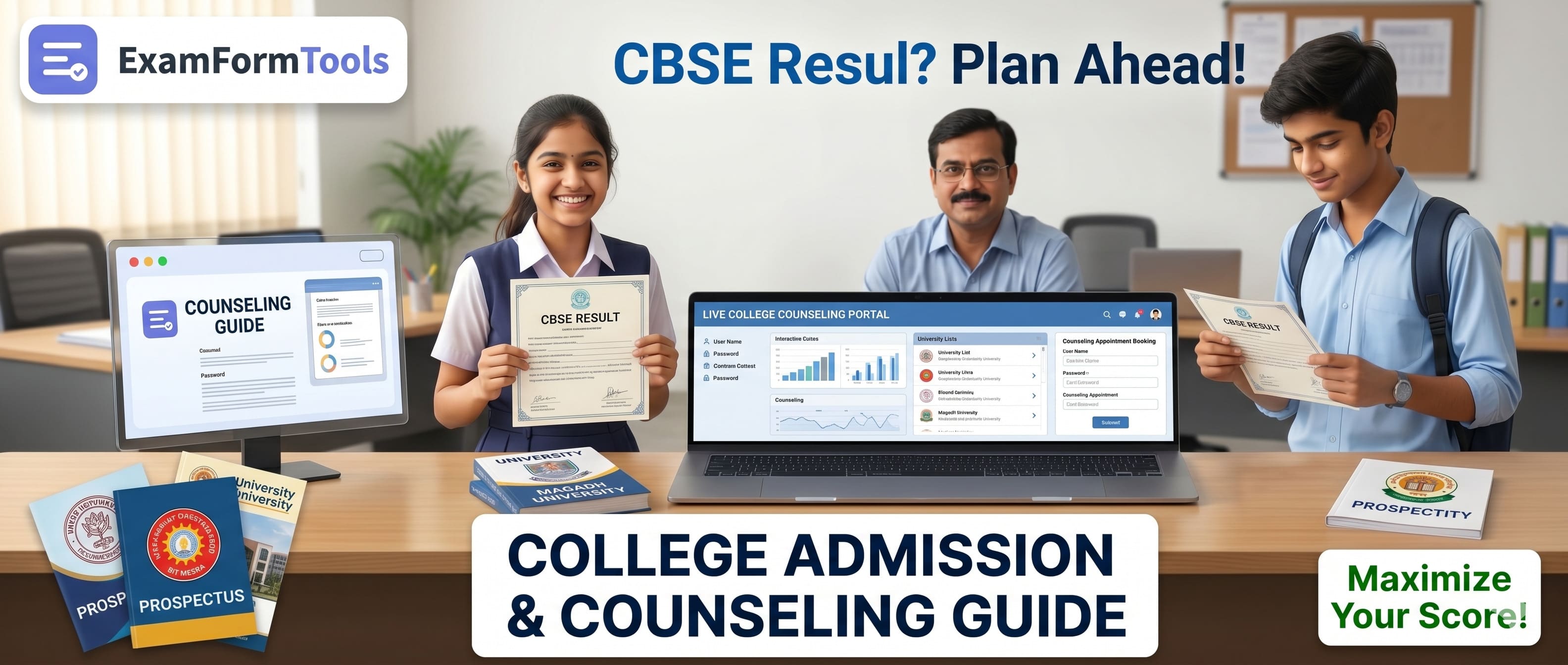
I watched my cousin spend Rs. 1.5 lakh with a “college counselor” who claimed to have insider knowledge about cutoffs. This person advised him to apply to colleges that were way above his score and skip safety colleges entirely. Result? Round 1: nothing. Round 2: nothing. Round 3: he barely got a seat at the last moment in a college he actually didn’t want to attend. He spent the first semester miserable before eventually transferring—losing a year in the process.
The tragedy? Every single decision the counselor made was based on a misunderstanding of how the cutoff algorithm works. Everything they told him was confidently wrong.
Here’s what I learned: the college admission process after your CBSE result isn’t mysterious or governed by insider secrets. It’s actually a well-defined, logical algorithm. The students who navigate it successfully aren’t the smartest ones—they’re the ones who take 3-4 hours to understand the process, fill their choices strategically, and then trust the system to work.
CBSE Class 12 Result 2026 - Next Steps: College Admissions, Merit Lists, Cutoff Scores & Counseling
Your CBSE result is just the beginning. Getting that scorecard is exciting, but what comes next often feels overwhelming: merit lists, cutoff scores, counseling rounds, and making one of the most important decisions of your life—choosing your college and stream.
This comprehensive guide will walk you through every step from result day to stepping into your college classroom. We’ll demystify merit lists, explain cutoff scores, break down the counseling process, and help you make smart college choices that align with your score, interests, and future goals.
Understanding Merit Lists
Before you can get admitted, you need to understand how colleges rank students.
What is a Merit List?
A merit list is an official ranking of students prepared by colleges or universities based on their examination performance. It determines who gets admission priority and to which colleges/streams.
Purpose of Merit Lists:
- Rank students fairly based on performance
- Allocate college seats fairly
- Ensure transparency in admission process
- Determine cutoff scores for different colleges
- Handle competition when seats are limited
Key Point: Your position on the merit list directly impacts which colleges you can get admission into.
Types of Merit Lists
Different authorities prepare different merit lists:
1. All India Merit Lists (Central Universities/National Level)
Used By:
- IITs (via JEE Advanced)
- NITs (via JEE Main)
- Central Universities (Delhi University, BHU, etc.)
- AIIMS/Medical colleges (via NEET)
Characteristics:
- Single merit list for entire India
- Seats allocated on all-India basis
- Same cutoff across all locations
- More competitive (competes with lakhs of students)
Example: JEE Main merit list ranks all 13+ lakh candidates attempting the exam
2. State Merit Lists
Used By:
- State Engineering colleges
- State universities
- State medical colleges
- Institutions within that state
Characteristics:
- Merit list within each state
- Less competition than all-India list
- Different cutoffs for different states
- May have state-specific eligibility
Example: Maharashtra Engineering merit list for state engineering colleges
3. College-Specific Merit Lists
Used By:
- Private universities (VIT, BITS, etc.)
- Independent private colleges
- Deemed universities
Characteristics:
- Each college prepares its own list
- Based on college’s entrance exam or CBSE marks
- Usually less competitive
- More seats available
Example: Manipal University separate merit list based on MANIPAL entrance exam
4. Category-Wise Merit Lists
Used By: Almost all colleges (government and private)
Categories:
- General Merit: Open for all students
- SC Merit List: Reserved for Scheduled Caste (minimum seats reserved)
- ST Merit List: Reserved for Scheduled Tribe
- OBC Merit List: Reserved for Other Backward Classes
- EWS Merit List: Economically Weaker Sections (relatively new)
Important: Cutoffs differ significantly across categories. SC/ST/OBC often have lower cutoffs due to reservation.
How You Are Ranked on Merit List
Ranking Criteria (in order of priority):
-
Primary Score:
- For Engineering: JEE Main score (sometimes board marks included)
- For Medical: NEET score
- For Direct Admissions: CBSE percentage or CGPA
-
Tie-Breaking (if two students have same score):
- Physics marks: Higher physics usually breaks tie (for science)
- Mathematics marks: Higher math rank preferred
- Board percentage: CBSE score considered
- Date of birth: Older candidate often gets priority (varies by state)
-
Special Considerations:
- Sports quota: Students with sports achievements
- Management quota: Management category seats (private colleges mainly)
- Reservation: SC/ST/OBC/EWS category seat reservations
- Physically Handicapped (PH) quota
Example Ranking:
Student A: JEE Score 250, Physics 95, Math 110 → Rank 1
Student B: JEE Score 250, Physics 90, Math 115 → Rank 2
(Though same score, Student A ranks higher due to physics)
Merit List Validity and Updates
Initial Merit List:
- Released after entrance exam results
- Shows rank and likely college chances
- Usually 5-7 days after exam result announcement
Multiple Rounds:
- Round 1: Based on initial list
- Round 2: After Round 1 admissions, updated list for remaining seats
- Round 3: After Round 2, another update
- Spot Round: Last-minute seats filling
Your Rank:
- Remains Fixed: Your rank doesn’t change in successive rounds
- Available Seats Change: Fewer seats in later rounds as students get admitted
- Cutoffs Drop: College cutoffs may drop in later rounds due to fewer seats
Cutoff Scores - What They Mean
This is the most important number after your result. Let’s decode it completely.
Understanding Cutoff Scores
Cutoff Score Definition: A cutoff score is the minimum score/rank required for a student to be eligible for admission to a particular college for a particular course in a particular category.
Non-Negotiable Rule: If your score is below cutoff, you don’t get admission to that college-stream combination, no matter what.
Example:
Delhi University B.Sc (Honours) Computer Science - General Category
Cutoff Score: 95%
If you score: 96% → Eligible for merit list review
If you score: 94% → Not eligible, no admission possible
Factors Affecting Cutoff Scores
Why do cutoffs vary across colleges?
-
College Reputation & Demand:
- Top colleges: Higher cutoffs (more applications)
- Average colleges: Lower cutoffs (fewer applications)
- Example: Delhi University cutoff > new private college cutoff
-
Number of Available Seats:
- More seats = Lower cutoff (easier to fill)
- Fewer seats = Higher cutoff (more competitive)
- Example: IIT Delhi (fewer seats) > NIT Delhi (more seats)
-
Course Popularity:
- Engineering in top college: Very high cutoff
- B.A. in same college: Lower cutoff
- Example: IIT CSE cutoff > IIT Mechanical cutoff
-
Previous Years’ Cutoffs:
- Exam difficulty affects cutoff
- Harder year: Lower cutoffs (fewer score high)
- Easier year: Higher cutoffs (more score high)
-
Reservation Categories:
- General category: Highest cutoff
- OBC: Slightly lower
- SC/ST: Significantly lower
- Example: Delhi University general cutoff 97% vs SC cutoff 88%
Important: Each college-stream-category combination has a DIFFERENT cutoff.
Typical Cutoff Ranges for 2026 (Approximate)
These are realistic benchmarks based on historical trends:
For Engineering B.Tech Admissions
| College Tier | Type | Typical Cutoff | JEE Rank Range |
|---|---|---|---|
| IIT | Top tier | 99th percentile | Top 250-500 ranks |
| NIT | Excellent | 95-98 percentile | Top 3000-8000 ranks |
| IIIT Delhi | Premier | 92-96 percentile | Top 10,000 ranks |
| Best Private | Very Good | 85-92 percentile | Top 20,000 ranks |
| Good State | Good | 75-85 percentile | Top 50,000 ranks |
| Average Private | Average | 65-75 percentile | Top 100,000 ranks |
| College Cutoff | Below Avg | 50-65 percentile | Top 200,000 ranks |
Key Point: JEE score matters, not CBSE marks (CBSE marks rarely directly used for engineering)
For Medical MBBS Admissions
| College Type | NEET Percentile | Seat Category | NEET Marks (out of 720) |
|---|---|---|---|
| AIIMS | 99.5+ | General | 680+ |
| Top Government | 99+ | General | 670+ |
| Good Government | 97-99 | General | 650-670 |
| State Medical | 94-97 | General | 620-650 |
| Good Private | 80-94 | General | 550-620 |
| Average Medical | 60-80 | General | 400-550 |
Note: NEET is entrance exam-based (similar to JEE); CBSE marks not primary factor
For Direct University Admissions (Arts/Commerce/Science)
| University | Course | Typical Cutoff | Category Variation |
|---|---|---|---|
| Delhi University | B.Sc Physics | 95-99% | General 95%, OBC 90%, SC 80% |
| Delhi University | B.Com | 90-96% | General 92%, OBC 85%, SC 75% |
| Delhi University | B.A. | 85-92% | General 88%, OBC 80%, SC 70% |
| BHU | B.Sc | 88-93% | General 90%, OBC 85%, SC 75% |
| Stella Maris | All Courses | 75-85% | Slightly lower for reservations |
| Private University | Any | 60-80% | May have lower cutoffs |
Important: Delhi University uses board marks (CBSE), not entrance exam
Reading and Interpreting Cutoffs
What Each Cutoff Term Means:
| Term | Meaning | Your Action |
|---|---|---|
| Closing Cutoff | Last rank admitted | Score above this to get admission |
| Opening Cutoff | Highest score admitted | Higher scores than this are safer |
| Vacancy Cutoff | Cutoff in later round | Drops as seats fill up |
| Merit Cutoff | Below which candidates not considered | Score below means no chance |
Using Cutoff to Assess Chances:
Your Score: 88%
Looking at Delhi University B.Sc Cutoff 95%

Can You Get Admission?
NO - Your score is BELOW cutoff

What If Cutoff Drops?
- In later rounds, some drop to 92% (fewer seats)
- You're still below, so unlikely even in later rounds

What Should You Do?
- Look at colleges with cutoffs: 80-88%
- Target those where you're above cutoff
Cutoff Timing and Changes
When Cutoffs Are Released:
- After merit list publication (1-2 days)
- Varies for each round (3-4 rounds typically)
- Final cutoff released after all admissions complete
How Cutoffs Change Across Rounds:
| Round | Seats Available | Typical Cutoff | Why |
|---|---|---|---|
| Round 1 | Most seats | Highest | Competition is high |
| Round 2 | Fewer seats (~30% less) | Drops 2-5% | Some admitted in R1 |
| Round 3 | More fewer seats (~50% less) | Drops 5-10% | More people admitted |
| Spot Round | Few leftovers (~10%) | Drops 10-20%+ | Last-minute filling |
Strategy: If below cutoff in R1, don’t lose hope - likely to improve in R2/R3.
Stream-Based Admission Processes
Different streams have completely different admission pathways. Let’s understand each.
Engineering B.Tech / B.E. Admissions
Eligibility Requirements:
- ✅ Physics, Chemistry, Mathematics in Class 12
- ✅ Minimum 50% marks in PCM (some colleges 40%)
- ✅ Appeared for entrance exam (JEE Main or state CET)
- ✗ Non-PCM students: NOT eligible
Admission Routes:
Route 1: JEE Main & Counseling (Most Common)
- Who: Students in Hindi/English medium schools mostly
- Process:
- Take JEE Main exam (in January & April)
- Get percentile rank
- Register on official state/AIQ counseling portal
- Fill college preferences
- Get allocation based on rank × preference
Route 2: State Engineering CET (State-Specific)
- Who: Students in that state wanting state colleges
- Examples: MAHCET (Maharashtra), WBJEE (West Bengal), VITEEE (Tamil Nadu)
- Process: Similar to JEE Main but for state colleges
Route 3: Direct College Admission (Merit-Based)
- Who: Some private colleges accept merit-based admissions
- Process: Direct application to college + interview
Merit Calculation:
Final Merit = (JEE Main Score: 80%) + (CBSE Marks: 20%)
OR
Final Merit = (CET Score: 90%) + (CBSE Marks: 10%)
(Varies by state/college)
Typical Cutoffs:
- IIT: NTA percentile 99+
- NIT: NTA percentile 95-98
- Private college: Percentile 70-90
Key Dates (Typical):
- JEE Main: Jan-April 2026
- Result: May 2026
- Counseling: June 2026
- College reporting: July 2026
Medical MBBS / BDS Admissions
Eligibility Requirements:
- ✅ Physics, Chemistry, Biology in Class 12
- ✅ Minimum 50% marks in PCB
- ✅ Appeared for NEET exam (mandatory, single national test)
- ✗ Non-PCB students: NOT eligible
Admission Routes:
Route 1: NEET-Based AIIMS & Top Medical (Competitive)
- Who: Top NEET scorers
- Process:
- Take NEET-UG exam (May annually)
- Get NEET rank
- Separate AIIMS counseling process
- Register for AIQ (All India Quota) counseling
- Choose college × branch
Route 2: State Quota Medical Colleges
- Who: State residents or those eligible for state quota
- Process:
- NEET rank based
- State-specific counseling
- State merit list prepared
- Allocation based on state preferences
Route 3: Private Medical Colleges
- Who: Students meeting eligibility, usually higher fees
- Process: NEET score based, direct admission
Merit Calculation:
Merit = NEET Score (100%)
CBSE marks are NOT used directly
(Some colleges may consider for tie-breaking)
Typical Cutoffs:
- AIIMS Delhi: NEET 99+ percentile (680+ marks out of 720)
- Top Government Medical: 98-99 percentile
- Average Government Medical: 94-97 percentile
- Private Medical: 60-90 percentile (varies)
Seat Distribution:
Out of 100 seats:
- All India Quota (AIQ): 15 seats
- State Quota: 85 seats
- Within State: General/OBC/SC/ST → Different cutoffs
Key Dates (Typical):
- NEET Exam: May 2026
- Result: June 2026
- AIIMS Counseling: June-July 2026
- State Counseling: July-August 2026
- College beginning: August 2026
Commerce B.Com / BBA Admissions
Eligibility Requirements:
- ✅ Any subject combination allowed (no strict requirements)
- ✅ Minimum 45-50% marks typically (varies by college)
- ✗ Entrance exam: Usually NOT required
- ✓ Merit-based: CBSE marks used directly
Admission Routes:
Route 1: Direct Merit-Based by Universities
- Process:
- Merit list prepared from CBSE marks
- Cutoff determined
- Direct admission if above cutoff
- No entrance exam needed
Route 2: College Entrance Exams (Some Colleges)
- Examples:
- DU entrance exam for certain courses
- Private college entrance exams
- CAT later for MBA (not at bachelor level)
Route 3: Test-Based (Some Colleges)
- Conducting their own aptitude test
- Merit from test scores
Merit Calculation:
Merit = CBSE Percentage (100%)
Best of 5/6 subjects considered
No entrance exam component
Typical Cutoffs:
- Delhi University B.Com: 90-96%
- BHU B.Com: 85-90%
- Private college: 70-85%
Popular Commerce Courses:
- Bachelor of Commerce (B.Com): 3 years
- BBA (Bachelor of Business Administration): 3 years
- Path to CA/CS: Foundation after 12th
Key Dates (Typical):
- Cutoff announcement: June 2026
- Application window: June 2026
- Admission: June-July 2026
- Classes begin: July-August 2026
Arts/Humanities B.A. Admissions
Eligibility Requirements:
- ✅ Any subject combination
- ✅ Minimum 40-45% typically (lowest barrier)
- ✗ Entrance exam: Usually NOT required for most colleges
- ✓ Merit-based: CBSE marks
Admission Routes:
Route 1: Direct Merit-Based (Most Common)
- No entrance exam
- CBSE marks determine admission
- Flexibility in subject selection
Route 2: Some Universities Have Entrance
- Delhi University offers some courses with entrance
- BHU offers entrance for some streams
- Mostly merit-based though
Merit Calculation:
Merit = CBSE Percentage (100%)
OR specific subjects selected (varies)
Typical Arts Courses:
- B.A. (General): 3 years
- B.A. (Honours): 3 years (single major subject)
- B.Sc (Science for arts stream): Physics, Chemistry, Math
- B.F.A. (Fine Arts): 4 years
- B.Lib (Library Science): 1 year diploma
Typical Cutoffs:
- Delhi University BA Hindi: 88-92%
- BHU BA: 82-87%
- Private college: 60-80%
College Counseling Process - Step-by-Step
This is where most confusion happens. Let’s break down the 7-step counseling process:
Step 1: Registration & Document Verification (Timeline: 1-2 weeks post-result)
What Happens:
- You register on official counseling portal
- Verify your eligibility
- Upload required documents digitally OR visit center
Documents Required:
- ✓ CBSE marksheet (photo/scanned copy)
- ✓ Admit card from exam
- ✓ ID proof (Aadhar/Passport/PAN)
- ✓ Caste certificate (if SC/ST/OBC)
- ✓ EWS certificate (if claiming EWS)
- ✓ PWD certificate (if disability)
- ✓ Migration certificate (if from different board)
- ✓ Character certificate from school
Registration Process:
- Visit official counseling website
- Click “New Registration”
- Enter roll number, DOB, email
- Create login credentials
- Upload documents as per checklist
- Submit for verification
- Get verification confirmation (may take 1-3 days)
Status Check:
- “Verification Pending”: Waiting for approval
- “Verification Approved”: Ready for choice filling
- “Verification Rejected”: Document issue - resubmit with corrections
Important: Don’t miss deadline or you can’t participate in counseling.
Step 2: Choice Filling (Timeline: 3-5 days, CRITICAL)
What This Means: You rank your preferred colleges + branches/subjects in order. Algorithm uses this to allocate seats fairly.
How Many Choices to Fill:
- Usually 75-100+ choices allowed
- Fill MAXIMUM allowed
- Don’t think “I’ll only apply to 10 good colleges”
Strategy for Choice Filling:
Tier 1: Dream Colleges (10-15% chance)
- Colleges with cutoff 2-4% above your score
- IIT Delhi (if your percentile supports)
- Delhi University merit (if just below cutoff)
- Fill these with realistic optimism
Tier 2: Target Colleges (50-70% chance)
- Colleges with cutoff EQUAL or slightly below your score
- Most of your choices should be here
- Where you’re likely to get admission
Tier 3: Safety Colleges (90%+ chance)
- Colleges with cutoff 5-10% below your score
- Ensure you get admission somewhere
- Don’t skip these despite high safety
Example Filling Strategy:
Your Score: 80%, Category: General

DREAM COLLEGES (cutoff 81-84%):
- College A - CSE
- College B - IT
- College C - ECE
(Fill 3-5 such)

TARGET COLLEGES (cutoff 75-80%):
- College D - CSE
- College D - IT
- College E - CSE
- College F - Mechanical
- College G - All streams
(Fill 30-40 such)

SAFETY COLLEGES (cutoff 70-75%):
- College H - All streams
- College I - All streams
- College J - All streams
- College K - All streams
(Fill 20-30 such)

ABSOLUTE SAFETY (cutoff 50-70%):
- College L - All streams
- College M - All streams
(Fill 5-10)

TOTAL: ~60-80 choices
Important Rules:
- Order matters: Your preference order is #1 for allocation
- Can’t change mid-round: Choice once locked is final
- Higher preferences get priority: Algorithm processes in your given order
- Fill honestly: Don’t put safety college first thinking you’ll get dream college
Step 3: Merit List Publication (Timeline: 2-3 days after choice filling)
What Happens:
- Counseling authority runs algorithm
- Processes all students’ choices and ranks
- Allocates college seats fairly
- Publishes merit cut-offs per college-stream
What You See:
- Your allocated college
- Your allocated stream/subject
- Reporting instructions
- Next action deadlines
Possible Outcomes:
- ✓ Got your first preference: Accept immediately
- ✓ Got a decent college: Good allocation
- ✗ Didn’t get any college: Likely got higher in later rounds or needs decision
Step 4: Acceptance & Reporting (Timeline: 2-3 days, CRITICAL)
What You Must Do:
- Accept the Seat: Go to online portal and click “Accept”
- Track Payment: Pay seat acceptance fee (₹1,000-10,000 depending on college)
- Upload Final Acceptance: Print and keep confirmation
- Report to College: Go to college on specified date (usually weekend)
At College Reporting Day:
- Meet at admission office
- Carry all original documents
- Complete admission formalities
- Pay first semester fees
- Get admission confirmation letter
- Get ID card and hostel info (if applicable)
Critical: Missing reporting deadline means seat cancellation and no backup option.
Step 5: Seat Acceptance Fee Payment
Purpose: To confirm your seat acceptance, prevent multiple seat holding
Fee Breakdown (Typical):
- Government colleges: ₹1,000-3,000
- Private colleges: ₹5,000-10,000
- Refundable: Usually yes, if you exit in later round
Payment Method:
- Online: Credit/Debit card, Net banking
- Offline: Bank transfer, check deposit
- Usually done on portal itself
Refund Policy:
- If you exit in later round: Usually 50-80% refund
- If you report to college: No refund
- Timeline: Up to 1 month after final round
Step 6: Subsequent Rounds (For Vacancies)
Round 2 Timeline: 3-4 days after Round 1 reporting
What Happens:
- Students who didn’t get seats in R1 get chance
- Students can upgrade to better college
- New merit list based on available seats
Your Decision:
- Option 1: Stay with R1 college (safe choice)
- Option 2: Try upgrading in R2 (risky - can lose R1 seat)
Upgrading Strategy:
- Only if significant better college available
- Must forfeit current seat to try upgrade
- If upgrade fails, you’re back to no seat
- Usually not recommended except in specific cases
How Many Rounds:
- Typically 3-4 counseling rounds
- Some colleges have spot round after (same day)
- Total process spans 1-1.5 months
Step 7: Final Admission & Enrollment
After All Rounds:
- Pay complete first semester fees
- Complete admission at college
- Begin academic year (usually August)
Documentation at College:
- Original marksheet
- Bonafide certificate
- Transfer certificate (migration)
- Caste certificate (if applicable)
- Medical fitness certificate
- Hostel application (if applicable)
Smart College Selection Strategy
Having understood the process, here’s how to make smart college choices:
Know Your Position First
Step 1: Find Your Rank/Percentile
- For Engineering: Your JEE Main percentile
- For Medical: Your NEET percentile
- For Direct: Your CBSE percentage
Step 2: Check Previous Years’ Cutoffs
- Visit college websites
- Check CSAB (JEE counseling authority)
- Look at your state counseling portal
- Note cutoffs for your category (important!)
Step 3: Realistic Assessment
Your Score: 250 rank in JEE (99.2 percentile)

Dream Colleges (achievable with luck):
- IIT Delhi (~99.5+ percentile)
- IIT Bombay (~99.8+)

Target Colleges (likely to get):
- NIT Delhi (~98-99)
- IIIT Delhi (~97-98)
- Good private colleges (~90-95)

Safety Colleges (very likely):
- State universities (~85-90)
- Average private colleges (~75-85)
Three-Tier College Selection Framework
Tier 1: Dream Colleges (10-15% Probability)
Characteristics:
- Top reputation nationally
- Highest package placements
- Hardest to get into
- Cutoff slightly above your rank
Examples:
- IIT Delhi, Mumbai, Kharagpur
- AIIMS Delhi, Bombay
- Delhi University (top streams)
- BHU for top courses
Why Include These:
- You might get lucky with preferences
- Algorithm might help your case
- No harm in trying in counseling
Strategy:
- Include 3-5 such colleges
- Fill them but don’t rely on them
- Have backup plan if you don’t get
Tier 2: Target Colleges (50-70% Probability)
Characteristics:
- Good reputation, decent opportunities
- Realistic cutoff match with your score
- Better value for effort
- Good placements
Examples:
- NIT colleges (tier 2, matching your rank)
- IIIT colleges
- Good private engineering colleges (VIT, Manipal, etc.)
- Good state universities
Why These Matter:
- Most of your choices should be here
- Where you’ll likely get admission
- Good career prospects
- Better luck with selections
Strategy:
- Fill 30-50 choices from this tier
- Variety of colleges at similar level
- Different branches too
Tier 3: Safety Colleges (90%+ Probability)
Characteristics:
- Adequate infrastructure
- Decent placements (not exceptional)
- Lower cutoff (below your score)
- Ensures you get admission
Examples:
- Lower-tier private colleges
- Average state universities
- Colleges 5-10% below your score
Why These Are Important:
- Guarantee admission somewhere
- Prevent being left without seat
- Allows you to take calculated risks
Strategy:
- Fill 10-15 safety college options
- Different streams/branches
- Don’t skip this tier!
Factors Beyond Cutoff to Consider
1. Infrastructure & Campus
- ✓ Lab facilities and equipment
- ✓ Library with updated books
- ✓ Computer center / IT infrastructure
- ✓ Sports facilities
- ✓ Classroom quality
- ✓ Hostel facilities (if relevant)
2. Faculty Quality
- Check faculty qualifications (PhD %)
- Industry experience of faculty
- Research publications/achievements
- Teaching methodology reviews
- Student feedback on faculty
3. Placement Records
- Average package offered
- Highest package offered
- Companies recruiting (top 10)
- Placement percentage (usually 85%+)
- Package growth year-over-year
- Salary distribution data
4. Location & Geography
- City: Metro vs tier-2 city (affects job opportunities)
- Accessibility: Easy to reach from home?
- Amenities: Shopping, food, entertainment
- Safety: Campus security, area safety
- Transportation: Public transport availability
- Cost of living: Significantly varies by city
5. Alumni Network
- Strength in industry
- Alumni mentoring programs
- Alumni placements in MNCs
- Networking opportunities
- Post-graduation support
6. Course Specializations
- Specializations offered (AI, Cloud, etc.)
- Flexibility in subject selection
- Internship opportunities
- Industry collaboration projects
- Minor degree options (if applicable)
7. Fee Structure & Financial Aid
- Total fees (semester-wise breakdown)
- Scholarship policies
- Educational loans available
- Fee waivers for top performers
- Financial aid for economically weaker students
8. Peer Group Quality
- Average cutoff of entering students
- Peers’ capabilities and caliber
- Diversity (regional, social, educational background)
- Competition level (helps growth)
- Collaboration opportunities
Research Tools & Resources
Official Sources:
- College official website
- CSAB portal (jeeadmissions.nic.in) for engineering
- MCC portal (mcc.nic.in) for medical
- State counseling authority website
- Previous years’ cutoff documents
Student Reviews:
- Quora (engineering college discussions)
- Reddit r/Indian_Academia
- YouTube: College reviews and vlogs
- Facebook groups: Alumni and student groups
- Instagram: Campus life photos
Ranking Platforms:
- NIRF Rankings (National Institutional Ranking Framework)
- QS World University Rankings
- Times Higher Education
- India Today college rankings
Professional Guidance:
- Career counselors (paid services available)
- Alumni mentors (many colleges facilitate)
- Seniors in college (informal guidance)
- Online webinars (many colleges host)
Documentation Required After Result
Don’t wait until admission date to gather documents. Start immediately:
Before Counseling Starts (Immediate)
From School:
- ✓ CBSE marksheet (4-5 original copies)
- ✓ School bonafide certificate
- ✓ Transfer certificate (character testimonial)
- ✓ School leaving certificate
- ✓ Certificate of eligibility (if needed)
Government Certificates:
- ✓ Caste certificate (SC/ST/OBC) - from block office
- ✓ EWS certificate (if applicable) - from income officer
- ✓ Disability certificate (PWD) - from medical board if applicable
- ✓ Non-creamy layer status (some states require)
Personal Documents:
- ✓ Birth certificate (from municipal corporation)
- ✓ Aadhar card (copy)
- ✓ Pan card (if you have)
- ✓ Passport (copy, if you have)
- ✓ voter ID (if you have)
- ✓ Photographs (10-15 color, 4x6 size)
During Counseling Registration
- ✓ Scanned copies of all above documents
- ✓ Digital photographs
- ✓ Email address and mobile number
- ✓ Backup phone number
For College Admission (Have Ready)
- ✓ Original marksheet
- ✓ Bonafide certificate
- ✓ Transfer certificate
- ✓ Character certificate
- ✓ Caste/EWS certificate
- ✓ Medical fitness certificate (from doctor)
- ✓ Passport-sized photographs (20+ copies)
- ✓ Aadhar card
- ✓ Bank account details (for fee payment)
- ✓ Insurance document (if needed)
Pro Tip: Get copies made now while you wait. Cost is ₹5-10 per page. Better to have extras than shortage later.
Common Mistakes to Avoid
Learn from others’ mistakes:
Mistake 1: Not Filling Enough Choices
❌ What Students Do:
- “I’ll only target 10 good colleges”
- Miss filling 90% of available choices
- Algorithm has limited options to work with
✅ What You Should Do:
- Fill 75-100+ choices as allowed
- Variety of colleges at different levels
- Let algorithm pick the best match
Mistake 2: Not Including Safety Colleges
❌ What Students Do:
- Fill only dream/target colleges
- Skip lower-tier colleges thinking “I won’t go anyway”
- Left without admission if things go wrong
✅ What You Should Do:
- Always include 10-20% safety options
- Ensures you have a seat somewhere
- Can always upgrade in later rounds
Mistake 3: Wrong Preferences Order
❌ What Students Do:
- Put safety college first hoping algorithm helps
- Misunderstand: Algorithm respects your order
- Get lower college because priority says so
✅ What You Should Do:
- Fill in your genuine preference order
- Algorithm works through your order
- Put best/dream colleges first
- Put safety colleges at the end
Mistake 4: Relying on “Leaked” Information
❌ What Students Do:
- Trust socialmedia predictions of cutoffs
- Follow unverified online forums for advice
- Make decisions on gossip
✅ What You Should Do:
- Only trust official cutoffs after announcement
- Refer to previous 2-3 years’ data
- Make decisions based on reliable sources
Mistake 5: Ignoring Location and Lifestyle
❌ What Students Do:
- Choose college purely on rank/package
- Ignore location, climate, city
- Regret heavily during 4 years
✅ What You Should Do:
- Consider city, climate, lifestyle
- Visit college before admission if possible
- Talk to seniors about daily life
- Balance reputation with comfort
Mistake 6: Missing Important Deadlines
❌ What Students Do:
- Forget document verification deadline
- Forget choice filling deadline
- Forget acceptance deadline
- Lose seat because of administrative miss
✅ What You Should Do:
- Mark all dates on calendar (phone + physical)
- Submit 1-2 days before deadline (not last day)
- Keep email and SMS alerts on
- Have backup contact person (parent/friend)
Mistake 7: Not Exploring All Counseling Rounds
❌ What Students Do:
- Get disappointed in Round 1, don’t participate in R2/R3
- Miss better college opportunity
- Accept mediocre college without trying
✅ What You Should Do:
- Participate in all rounds (3-4 usually)
- Upgrade in later rounds if better college available
- Later rounds often have lower cutoffs
- Maximum chances of good college
Mistake 8: Choosing Stream Based on Trends, Not Interest
❌ What Students Do:
- Select Engineering because “everyone’s doing it”
- Hate the subject but stuck for 4 years
- Struggle with studies and placements
✅ What You Should Do:
- Reflect on your real interests
- Engineering needs strong math/science
- Medical needs dedication to memorization
- Commerce/Arts for business/arts inclination
- Choose based on interest + aptitude
Timeline & Important Dates Calendar
Typical Post-Result Timeline (May-September 2026)
MAY 2026:
├─ June 5: CBSE Result Announcement (2:00 PM)
├─ June 5-7: Check result, download marksheet
├─ June 8-10: Get physical copies from school
└─ June 10-12: Entrance exam results (if applicable)

JUNE 2026:
├─ June 13-15: Registration & document verification opens
├─ June 15-20: Complete registration before deadline
├─ June 21-22: Verification confirmation
├─ June 23-28: Choice filling (CRITICAL 5-7 day window)
├─ June 29-July 1: First merit list published
└─ July 1-3: Seat acceptance and fee payment

JULY 2026:
├─ July 4-7: Reporting to college
├─ July 8-10: Second round choice filling
├─ July 12-14: Second merit list + reporting
├─ July 15-17: Third round (if applicable)
└─ July 18-25: Final admissions and enrollment

AUGUST 2026:
├─ August 1-5: Hostel check-in
├─ August 10-15: Induction/orientation program
└─ August 15-20: Classes begin

SEPTEMBER 2026:
└─ Academic year in full swing
State-Specific Variations
Different states have different calendars. Check your state’s official portal for exact dates:
- Maharashtra: Slightly later (June 20 onwards)
- Delhi: Earlier rounds (June 10 onwards)
- Karnataka: Later (July onwards)
- Tamil Nadu: Via separate process
Frequently Asked Questions
Q1: What if I score below the cutoff for my dream college?
A: You have three approaches:
- Look at Later Rounds: Cutoffs often drop 5-10% in Rounds 2/3 as seats fill
- Try Upgrade: In later rounds, upgrade to better college (risky - can lose current seat)
- Target Colleges: Focus on colleges where you’re above cutoff (safer strategy)
Q2: Can I take admission then transfer to another college?
A: Technically yes, but with complexities:
- During counseling: Easy to switch in next round
- After admission: Transfer is very difficult, college won’t grant NOC easily
- Academic credit transfer: Complex, may lose credits
- Best approach: Choose carefully in counseling, don’t regret after admission
Q3: What if I don’t get any college after all rounds?
A: Unlikely but possible in competitive scenarios:
- Spot Round: Most counseling authorities conduct spot round for leftover seats (lower cutoffs)
- Waiting List: Some colleges keep waiting list, may get offer if someone exits
- Private Colleges: Still options available (may be expensive)
- Next Year: Can appear again with improved score
Q4: Should I participate in management quota or private college if below merit cutoff?
A: Personal decision:
Management Quota Pros:
- Guaranteed admission
- Still good college if legitimate
Management Quota Cons:
- Much higher fees (2-4x regular)
- Quality may be lower
- Seats for weaker candidates
Decision: If affordable and college decent, could work. Otherwise, aim well in merit counseling.
Q5: Can I defer admission to next year?
A: Depends on college policy:
- Government colleges: Usually NO deferment allowed
- Private colleges: Many allow 1-year gap (some conditions)
- Procedure: Apply for deferment to college principal in writing
- Conditions: May need valid reason (health, personal, etc.)
Better approach: Don’t defer if admission available.
Q6: How much should I spend on college selection process?
A: Minimal spending needed:
- Free: Online research, websites, YouTube
- Small cost: Travel for college visit (₹500-2000)
- Counselor: If hiring, ₹5,000-20,000 (optional)
- Contingency: ₹2,000-5,000 for document making
- Total: Can be done on ₹5,000-10,000 maximum
Q7: What if my category (SC/ST/OBC) cutoff is very low, should I use it?
A: This is personal, but strategic perspective:
- Advantage: Lower cutoff = easier admission to good college
- Consideration: Available if you belong to that category legitimately
- No harm: You’re eligible, use it to get better college
- Recommendation: Try merit first, if not available, use category
Q8: Can I change my stream/subject after getting admission?
A: Usually very difficult:
- Same Subject Change: Very difficult (requires approval)
- Different Stream: Nearly impossible after admission
- Wait until college: Some freedom in electives, not streams
- Important: Choose stream carefully during counseling
Final Roadmap: From Result to College
Here’s your action plan:
Week 1 (Result announcement):
- ✓ Check result online
- ✓ Download marksheet
- ✓ Take screenshots
- ✓ Order physical copies from school
- ✓ Celebrate appropriately!
Week 2 (Immediate preparation):
- ✓ Gather all required documents
- ✓ Make certified copies
- ✓ Research colleges realistically
- ✓ Check previous years’ cutoffs
- ✓ Register for entrance exam (if applicable)
Week 3-4 (Counseling registration):
- ✓ Register on counseling portal
- ✓ Upload documents before deadline
- ✓ Get verification confirmation
- ✓ Study college options thoroughly
- ✓ Create preference list
Week 5-6 (Choice filling and allocation):
- ✓ Fill maximum choices in correct order
- ✓ Review ranking before final submission
- ✓ Wait for merit list
- ✓ Accept allocated college
- ✓ Pay acceptance fee
Week 7-8 (Reporting and admission):
- ✓ Report to college
- ✓ Complete final admission
- ✓ Pay first semester fees
- ✓ Get admission letter and ID
- ✓ Arrange hostel (if needed)
Week 9+ (College begins):
- ✓ Attend orientation
- ✓ Make new friends
- ✓ Focus on studies
- ✓ Enjoy new chapter of life!
Key Takeaways
- Merit List: Your rank on it determines college eligibility - act fast after result
- Cutoff Scores: Non-negotiable minimum - must be above to get admission
- Engineering/Medical: Entrance exam based (JEE/NEET) - board marks have limited role
- Commerce/Arts: Direct board marks based - CBSE percentage is key
- Three-Tier Strategy: Dream (10-15%) + Target (50-70%) + Safety (90%+)
- Counseling Process: 7 steps from registration to college admission - no shortcuts
- All Rounds Matter: Later rounds offer lower cutoffs and upgrade chances
- Documentation: Start gathering immediately - don’t rush last minute
- Deadlines are Strict: Missing even one deadline means losing seat - use calendar alerts
- Location Matters: Choose college considering city lifestyle and infrastructure, not just rank
Final Thought
Your CBSE Class 12 result is important, but it’s just one factor in your overall journey. What matters more is how you respond to your result and the thoughtful choices you make in the next 2-3 months.
Whether you scored 55% or 95%, there’s a good college and a great future waiting for you. The key is making informed, deliberate decisions rather than reactive choices. Use this guide, research thoroughly, and trust your instincts.
Your college choice now will influence the next 4 years significantly. Choose wisely. Your future self will thank you! 🎓
Related Resources
- CBSE Class 12 Result 2026 - Official Release Date & How to Check Online
- Understanding Your CBSE Score: Marks Calculation & CGPA Explained
- Complete CBSE Class 12 Syllabus Guide - All Subjects 2026
- JEE Main vs Advanced: Complete Preparation Guide
- NEET Exam Guide: Eligibility, Syllabus, Preparation Tips
Last Updated: April 2026 | This guide is based on official counseling procedures and historical admission data. For latest updates and state-specific information, always check your state’s official counseling portal and college websites.