CUET UG Form Fill Guide: Photo, Signature, Category Certificate, and Common Rejection Fixes
Practical CUET UG form filling guide covering photo and signature uploads, category certificate checks, common rejection reasons, and final submission strategy.
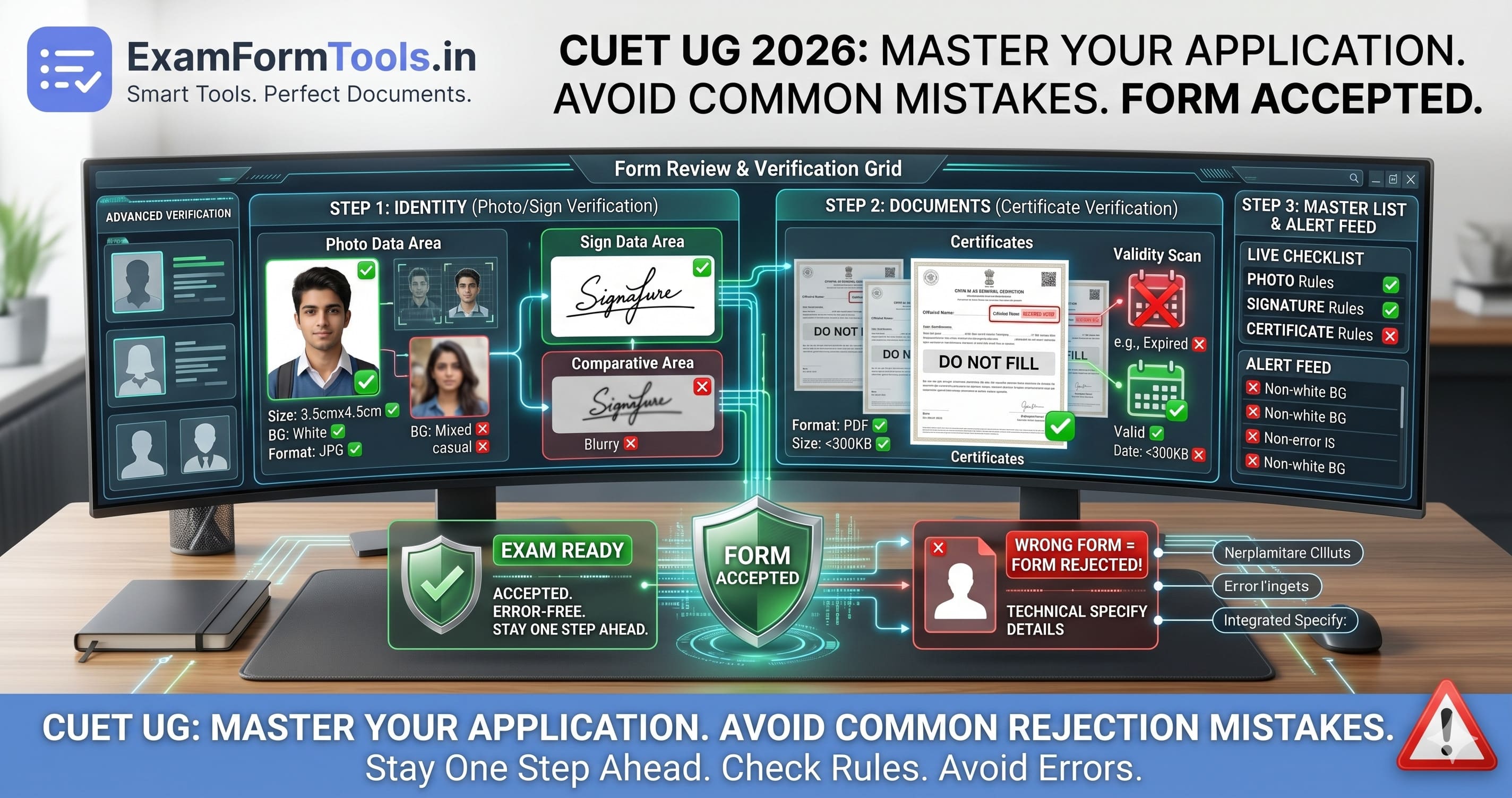
I remember sitting with my cousin last year when she was filling out her CUET UG application. Everything seemed straightforward until we hit the document upload section. Her photograph looked perfect on her phone, but after uploading, the portal kept throwing an error: “File size exceeds limit.” We tried compressing it three times, and on the third attempt, the image became so pixelated that you could barely make out her face. That’s when I realized something important—most CUET form rejections don’t happen because students aren’t eligible. They happen because of these tiny technical mistakes that snowball into major headaches during verification.
CUET UG has evolved into one of the largest university entrance gateways in India. With lakhs of applications flooding in each cycle, even the smallest documentation error can delay your admission process or worse, lead to outright rejection. The frustrating part? Most of these errors are completely preventable if you know what to watch out for.
This isn’t going to be one of those generic guides that just lists the official requirements. Instead, I’m sharing the actual, practical workflow that has helped dozens of students I’ve guided submit their CUET forms correctly on the first try—without last-minute panic, without multiple correction attempts, and definitely without those 11 PM calls asking “What do I do now?”
Why CUET Form Errors Are More Common Than You Think
Here’s something that might surprise you: according to unofficial estimates from student forums and community groups, nearly 15-20% of CUET applications face some form of technical rejection or require corrections during the window period. That’s one in every five applications.
The problem isn’t that students are careless. The problem is that CUET, being a relatively newer exam format compared to JEE or NEET, doesn’t have the same level of widespread practical knowledge yet. Your older siblings might have given you tips about JEE Main forms, but CUET? Most families are experiencing it for the first time.
Add to this the fact that the NTA portal has very specific requirements—not just guidelines, but hard technical limits—on file sizes, dimensions, formats, and naming conventions. Miss one of these by even a small margin, and you’re stuck in an endless loop of re-uploading and refreshing.
The Document Preparation Phase: Setting Yourself Up for Success
Before you even think about opening the CUET application portal, you need to gather and prepare your documents properly. This isn’t busywork—this is the foundation of a smooth application process.
Creating Your CUET Application Folder
On your computer (not just your phone), create a dedicated folder called something like “CUET_2026_Application.” Inside this main folder, create three subfolders:
- Originals - This is where you keep your untouched, high-quality source files. Never edit these directly.
- Portal_Ready - This is where you’ll save the compressed, resized, properly formatted versions ready for upload.
- Backups - This is where you’ll save every confirmation page, payment receipt, and submission PDF.
This three-folder system has saved countless students from disaster. Why? Because when your first upload fails (and it might), you can always go back to the original and create a fresh version instead of editing an already compressed file multiple times, which degrades quality exponentially.
What You Need to Have Ready
Let’s talk about the actual documents you need, beyond what the official notification says:
For the photograph:
- Get a professional passport-size photo taken—yes, physically go to a photo studio if possible. Those phone camera selfies with background removal apps might work, but they’re riskier. A professional photographer knows the lighting, the angle, and the background requirements that government portals typically expect.
- If you’re doing it yourself (which is fine), use a plain wall as your background. Natural window light from the front works best. Have someone take the photo from about 4-5 feet away, not too close.
- Make sure your entire face is visible—no hair covering your forehead or ears, no tilted angles, and definitely no sunglasses or accessories unless they’re religious/medical necessities.
- Wear formal or semi-formal clothing. It sounds minor, but verification officers are human beings, and a well-presented photo creates a better impression.
For the signature:
- Please, please don’t use your finger on a phone screen to create a signature. I’ve seen students do this, and the result looks like a 5-year-old drew it.
- Take a clean white sheet of paper—not a notebook page with lines, not colored paper.
- Use a blue or black pen (blue usually works better for scanning as it creates better contrast).
- Sign naturally, exactly how you’ll sign in the exam hall later. This consistency matters during document verification.
- Use a proper scanner if available, or take a very clear photo under good lighting. Hold your phone directly above the paper, not at an angle.
- Crop it carefully. Your signature should occupy most of the image space, but leave a small white border on all sides—about 2-3mm.
For certificates (SC/ST/OBC-NCL/EWS/PwBD): This is where a huge number of students face rejection, so pay extra attention here.
- First, check the validity period requirement in the current year’s official notification. For example, EWS certificates are typically valid for one financial year only, while OBC-NCL certificates might have different validity windows.
- Look at your certificate carefully. Is the issuing authority’s name and seal clearly visible? Is the certificate number readable? Is your name spelled exactly as it appears in your Class 10 marksheet?
- Here’s a common mistake: students upload their own OBC certificate when they should be uploading their parent’s income certificate for OBC-NCL verification. Read the requirements carefully.
- Scan your certificates at a reasonable quality—300 DPI is ideal if you’re using a scanner. If you’re photographing them, make sure there’s no shadow, no glare, and all four corners of the certificate are visible in the frame.
- Save each certificate individually with a clear filename like “OBC_Certificate_Rajesh_Kumar.pdf” not “IMG_20260318_143422.pdf”
Additional documents many students forget about:
- Your Class 10 marksheet (for name verification and DOB proof)
- Your Class 12 marksheet or expected marks statement
- Your Aadhaar card details (sometimes required for verification)
- A working phone number that YOU have access to, not a parent’s number that they might not keep handy during OTP verification
- An email address that’s professional (avoid usernames like [email protected]—admission committees do notice these things)
Understanding Photo and Signature Specifications: The Technical Details That Matter
Let’s get into the specifics that the NTA portal actually checks. These aren’t suggestions—these are hard requirements programmed into the upload system.
Photo Specifications Breakdown
Typical CUET photo requirements (verify with current year notification):
- Dimensions: Usually around 3.5 cm × 4.5 cm (passport size)
- File size: Between 10 KB to 200 KB (this is the tricky part)
- Format: JPG or JPEG (avoid PNG unless specifically allowed)
- Color: Color photos preferred, black and white sometimes rejected
- Resolution: At least 200 DPI
The challenge is this: a natural, good-quality photo at 3.5×4.5 cm and 200 DPI usually comes out to be around 300-500 KB. You need to compress it down to under 200 KB without making it look terrible. Here’s how:
- Start with your high-quality original photo (the one in your “Originals” folder)
- First, resize the dimensions to exactly what’s required—don’t just compress without resizing
- Then compress gradually—reduce quality to 85%, check the file size and image clarity, then if needed go to 80%, then 75%
- Stop when you hit the size requirement while the image still looks clear when you zoom in 200%
- Save this version in your “Portal_Ready” folder
Common mistakes to avoid:
- Using beauty filters or face-smoothing apps—verification software can detect these
- Wearing accessories that cover your face or create shadows
- Having other people or objects visible in the background
- Using photos that are more than 6 months old
- Using photos from other platforms that have already been compressed multiple times (like WhatsApp profile pictures)
Signature Specifications Breakdown
Typical requirements:
- Dimensions: Usually 3.5 cm × 1.5 cm (rectangular strip)
- File size: Between 10 KB to 100 KB
- Format: JPG or JPEG
- Clarity: All strokes must be clearly visible
Here’s what happens during verification: your uploaded signature will be compared with the signature you’ll make on the attendance sheet during the actual exam. If there’s a significant difference, it can raise red flags during document verification, especially if you progress to counseling rounds.
So whatever signature you upload, practice it a few times and memorize it. It doesn’t have to be fancy—it just has to be consistent.
Warning signs that your signature upload might get rejected:
- The signature has uneven lighting (one side darker than the other)
- There are visible creases or folds in the paper
- Your finger or the edge of your phone is visible in the crop
- The signature looks pixelated or has jagged edges after compression
- There’s too much white space, making the signature look tiny in the preview
- The file format is wrong (some students accidentally upload in .png or .webp)
Handling Category and EWS Certificates: The Fine Print
This section is specifically for students applying under reserved categories or EWS quota. If you’re applying under General category without EWS, you can skip this, but I’d recommend reading it anyway because you might help a friend later.
OBC-NCL Certificate Mistakes
The OBC (Non-Creamy Layer) certificate is probably the most frequently rejected document in CUET applications. Why? Because the validity and format requirements are very specific, and they keep changing.
Key things to verify:
- The certificate must be issued by a competent authority (usually Tehsildar or SDM level, not lower)
- It must specifically mention “Non-Creamy Layer” or “NCL”—a certificate that just says “OBC” is not sufficient
- The income details must be for the relevant financial year (usually the year before the admission cycle)
- Your parent’s occupation and income must be clearly mentioned
- If one parent is deceased, there should be appropriate documentation
- The certificate must be issued in the name of the candidate (you), not just in your parent’s name
I’ve seen students upload their father’s OBC certificate thinking it applies to them. It doesn’t work like that—you need your own certificate that establishes your category status.
EWS Certificate Challenges
The EWS (Economically Weaker Section) quota is relatively new, and many families are still figuring out the documentation requirements.
Critical points:
- EWS certificates are typically valid for only one financial year
- Your family’s annual income must be below ₹8 lakhs (as of current rules, but verify this for your application year)
- The certificate must explicitly state “EWS” or “Economically Weaker Section”
- Agricultural land ownership and residential property ownership details must meet the specified criteria
- If your family income seems borderline, ensure all the supporting documents match what’s stated in the certificate
Common rejection scenario: Student applies with an EWS certificate issued in March 2025 for the financial year 2024-25, but the admission notification requires certificates for financial year 2025-26. Result? Rejection during document verification.
PwBD (Persons with Benchmark Disability) Certificates
If you’re claiming benefits under PwBD category:
- The disability percentage must meet the minimum requirement (usually 40% or more)
- The certificate must be issued by a medical board of at least 3 doctors
- The disability type must be clearly specified
- The certificate format should match the current government standards (some older formats aren’t accepted)
The Application Fill-Up Process: Step-by-Step Walk-Through
Now that your documents are ready, let’s talk about actually filling the form. This seems simple, but there are strategic ways to do it that minimize errors.
Day 1-2: The Information Entry Phase
Don’t try to complete everything in one sitting. You’re human, and humans make typos when they’re rushing.
Strategy:
- Fill your basic details in one focused session—name, date of birth, parents’ details, address
- Cross-check every single field against your official documents
- For name spelling, look at your Class 10 marksheet, not your Aadhaar card (Class 10 is usually considered more authoritative for educational purposes)
- For date of birth, double-check the format required (DD-MM-YYYY or MM-DD-YYYY)
- Save as draft after completing each section
Common mistakes in this phase:
- Using your nickname instead of official name
- Confusing month and day in date format
- Using an email address you don’t regularly check
- Providing a phone number that belongs to someone who’s usually busy during the day
- Misspelling your parent’s name (this matters for verification)
Day 3-4: The Upload Phase
This is where most technical problems occur. The portal might be slow, uploads might fail, file size errors might appear—expect some friction here and don’t let it stress you out.
Upload order strategy:
- Upload the photograph first. If this fails multiple times, you know you have a format problem and can fix it before dealing with other documents.
- Then upload the signature.
- Then upload category certificates (if applicable).
- Then any additional documents required.
- After each successful upload, take a screenshot of the confirmation message.
What to do when uploads fail:
- Don’t panic and don’t immediately compress again—first check if it’s a portal issue by refreshing the page
- Try a different browser (Chrome works best with most NTA portals, but sometimes Firefox or Edge work when Chrome doesn’t)
- Clear your browser cache and cookies
- Try uploading during off-peak hours (early morning or late night when traffic is lower)
- If file size is the issue, go back to your original file and compress again from scratch—don’t compress an already compressed file
After successful upload:
- Preview each uploaded file directly on the portal
- Zoom in and check if your photo is clear
- Check if the signature is visible properly
- Verify that PDF certificates are opening and readable
Day 5-6: The Review and Verification Phase
Before you hit that payment button, do a complete audit. Yes, this sounds tedious, but finding a mistake now is infinitely better than finding it after you’ve paid.
The Pre-Payment Checklist:
- Print out or open the preview of your filled application
- Read through your name letter by letter—not just a glance, but actually reading it out loud
- Verify date of birth
- Check your category selection
- Verify exam center choices (this is important—pick centers that are realistically accessible to you)
- Check the course preferences you’ve selected
- Verify your contact information one more time
- Have a parent or friend review it with you—fresh eyes catch mistakes you might have overlooked
I can’t stress this enough: this verification phase has caught critical errors for at least 60% of the students I’ve helped. One girl had written her mother’s name in the “Father’s Name” field. Another student had accidentally selected the wrong exam center location. These mistakes would have been expensive and frustrating to fix later.
The Payment Process: Getting It Right the First Time
Now comes the financial part. CUET application fees vary based on category and number of courses selected, so check the current fee structure in your notification.
Before initiating payment:
- Have the money ready in your payment account (not just barely enough—keep a buffer in case of multiple deductions due to technical issues)
- Know which payment method you’re using (debit card, credit card, net banking, UPI)
- Make sure you’re on a stable internet connection—payment gateway timeouts are a real problem
- Keep your phone nearby for OTPs
- Close all unnecessary browser tabs and applications
During payment:
- Double-check the amount displayed
- Don’t refresh the page or press back button while payment is processing
- If the page seems stuck, wait at least 3-5 minutes before doing anything
- Note down the transaction ID/reference number immediately after payment
After payment:
This is crucial—don’t assume payment success means application success.
- Wait for the payment confirmation page to load completely
- Take screenshots of the confirmation
- Check if your application status has changed to “Payment Successful” or “Application Complete”
- Download the payment receipt PDF
- Check your email for confirmation (it might take a few minutes)
- If payment went through but application status isn’t updating, wait for 2-3 hours before contacting support
The dreaded “Payment successful but application pending” scenario:
This happens more often than you’d think. Here’s what to do:
- Don’t panic and don’t make another payment immediately
- Logout and login again to check application status
- Check your bank statement or UPI history to confirm if money was actually deducted
- If money was deducted but status isn’t updated after 24 hours, contact the helpdesk with your transaction ID, application number, and bank reference number
- Keep all proof of payment saved
Understanding the Correction Window: Your Safety Net
After the application submission deadline, NTA usually provides a correction window—typically a 2-3 day window where you can modify certain details. But don’t treat this as a backup plan to be careless during initial filling.
What you CAN usually correct:
- Spelling mistakes in name (with proof)
- Category changes (with proper documentation)
- Exam center choice modifications
- Course/subject preference changes
- Upload of better quality photographs or signatures
What you CANNOT usually correct:
- Date of birth (almost never allowed)
- Gender
- Parent’s name (usually not allowed)
- Email address and phone number (sometimes locked)
The correction window isn’t infinite, and some changes require documentary proof, so don’t assume everything is fixable later.
How to use the correction window effectively:
- Mark the correction window dates immediately after you submit your initial application
- Set a reminder 2 days before the window opens
- Prepare any required supporting documents in advance
- Login 10-15 minutes after the correction window opens (avoid the initial rush)
- Make changes carefully and verify before re-submitting
- Download a fresh copy of your corrected application
The Final Submission and Backup Phase
Congratulations—you’ve filled everything, uploaded all documents, completed payment. You’re almost done, but there’s one critical final step many students skip: creating a comprehensive backup.
Immediate post-submission tasks:
-
Download the complete application PDF - This is your primary proof of submission. Don’t just save it—open it and verify that all details are visible and correct.
-
Download and save the payment receipt - Save this separately, don’t rely on just the email confirmation.
-
Take screenshots of the final confirmation page - Include the one that shows your application number and submission status.
-
Save all documents in multiple locations:
- Your computer’s hard drive
- A cloud storage service (Google Drive, OneDrive, Dropbox—anything you have access to)
- Email them to yourself as an additional backup
- If possible, take a printout of the final application
-
Create a note with critical information:
- Application number
- Payment transaction ID
- Date and time of submission
- Your login credentials (stored securely)
- The helpdesk contact information
One of my friend’s younger brother had a situation where he forgot his application number and his email got hacked 2 weeks before the CUET exam. He couldn’t download his admit card because he had no record of his application number anywhere else. It took him 3 days of running to cyber cafes, checking old browser history, and finally contacting NTA support to retrieve it. Don’t be that person.
Common Problems and Real Solutions
Let’s talk about the issues students actually face, beyond the theoretical stuff.
Problem 1: “My photograph keeps getting rejected no matter what I do”
Real solution:
- Don’t keep editing the same file over and over. Go back to the original, unedited photo.
- Use a professional photo editing tool, or better yet, visit a local digital studio and ask them to prepare an exam application photo according to NTA specifications—most studios now offer this service for ₹20-50.
- Ensure your original photo is well-lit and sharp before you even start resizing.
- If you’ve tried everything and it’s still failing, try taking a fresh photo. Sometimes the problem is the source image quality, not the compression.
Problem 2: “The portal keeps timing out during document upload”
Real solution:
- Switch to a wired internet connection if possible, or use mobile data instead of WiFi (or vice versa).
- Upload during off-peak hours—try between 6 AM to 8 AM or 11 PM to 1 AM.
- Reduce your file sizes even more than required—if the max is 200 KB, aim for 150 KB.
- Use Chrome browser in incognito mode with all extensions disabled.
- If you’re using a very old computer or phone, try borrowing a friend’s newer device—sometimes the issue is hardware-related.
Problem 3: “I filled the wrong exam center and the correction window is closed”
Real solution:
- Contact NTA support immediately via their official email and helpdesk number.
- Prepare a written request explaining the mistake with your application details.
- Be polite and factual in your communication—don’t be demanding, explain how the error occurred.
- Follow up every 48 hours if you don’t get a response.
- In parallel, be mentally prepared to travel to the center you selected—it’s not ideal, but it’s still doable.
Problem 4: “There’s a spelling mistake in my name and I can’t correct it”
Real solution:
- If the correction window is still open, use it immediately with supporting documents (Class 10 marksheet usually).
- If the window is closed, submit a formal correction request to NTA as soon as possible.
- Carry multiple copies of your Class 10 marksheet, Class 12 marksheet, and an affidavit explaining the correct spelling to the exam center on exam day.
- If the spelling difference is minor (like “Kumar” vs “Kumarr” or an extra space), it usually gets resolved during document verification, but document it properly.
Problem 5: “Payment was deducted twice and I have two application numbers”
Real solution:
- Immediately email NTA support with both transaction IDs, both application numbers, and your bank statement showing both deductions.
- Request cancellation and refund of one application.
- Keep one application active and maintain that one carefully.
- Follow up on the refund request—government refunds can be slow, but they do happen if you provide proper documentation.
- Don’t try to maintain both applications thinking one is a backup—it can create complications during result declaration.
The Last-Mile Strategy: Avoiding Submission Day Panic
I’ve seen way too many students trying to submit their CUET forms at 11 PM on the last day. The portal is crawling, payment gateways are timing out, stress levels are through the roof, and parents are panicking. Don’t do this to yourself.
The smart timeline:
45-50 days before deadline: Read the official notification thoroughly. Mark important dates. Gather all documents.
30-40 days before deadline: Get your photographs and signature prepared professionally. Get fresh category certificates if needed.
20-25 days before deadline: Fill the application form, but save as draft. Don’t rush.
15-18 days before deadline: Review your filled form with parents and a teacher if possible. Upload all documents.
10-12 days before deadline: Complete payment and final submission.
Remaining days: Relax, and prepare for the actual exam.
This timeline ensures you’re never in a panic situation. If something goes wrong during upload or payment, you have plenty of time to fix it.
Why this matters psychologically:
Submitting your form well in advance gives you mental peace. You can then focus 100% on exam preparation without the nagging worry of whether your form was accepted or whether you’ll be able to download the admit card. That peace of mind translates to better preparation and better performance in the actual exam.
Final Thoughts: Treating CUET Application as Part of Your Preparation
Here’s a perspective shift that helped many students I’ve mentored: don’t treat the CUET application form as separate from your exam preparation. It’s actually the first test of your ability to follow instructions precisely, manage deadlines, handle technical challenges, and work under specific constraints—all skills you’ll need in the exam and in university life.
Students who approach the application process with the same seriousness they approach their syllabus tend to have smoother experiences overall. They’re more organized, less stressed, and they start their preparation journey with confidence.
The difference between a rejected application and an accepted one is rarely eligibility. It’s almost always about attention to detail, following the process correctly, and not leaving things to the last moment.
CUET is your gateway to some excellent universities across India. The application form is just the first door to that gateway. Open it properly, walk through confidently, and then focus your energy on what really matters—preparing well enough to get into the program of your dreams.
Remember: the few hours you invest in filling your CUET form carefully today will save you from weeks of potential stress and uncertainty tomorrow. Take it seriously, take it step by step, and you’ll be absolutely fine.
And if you’re reading this the night before the deadline? Take a deep breath. Follow the checklist above. Focus on accuracy over speed. You’ve still got this.
Good luck!