Railway RRB Form Fill Guide: Zone Preference Strategy and Document Upload Readiness
Complete RRB application guide covering zone preference logic, certificate readiness, and document consistency across CBT and verification stages.
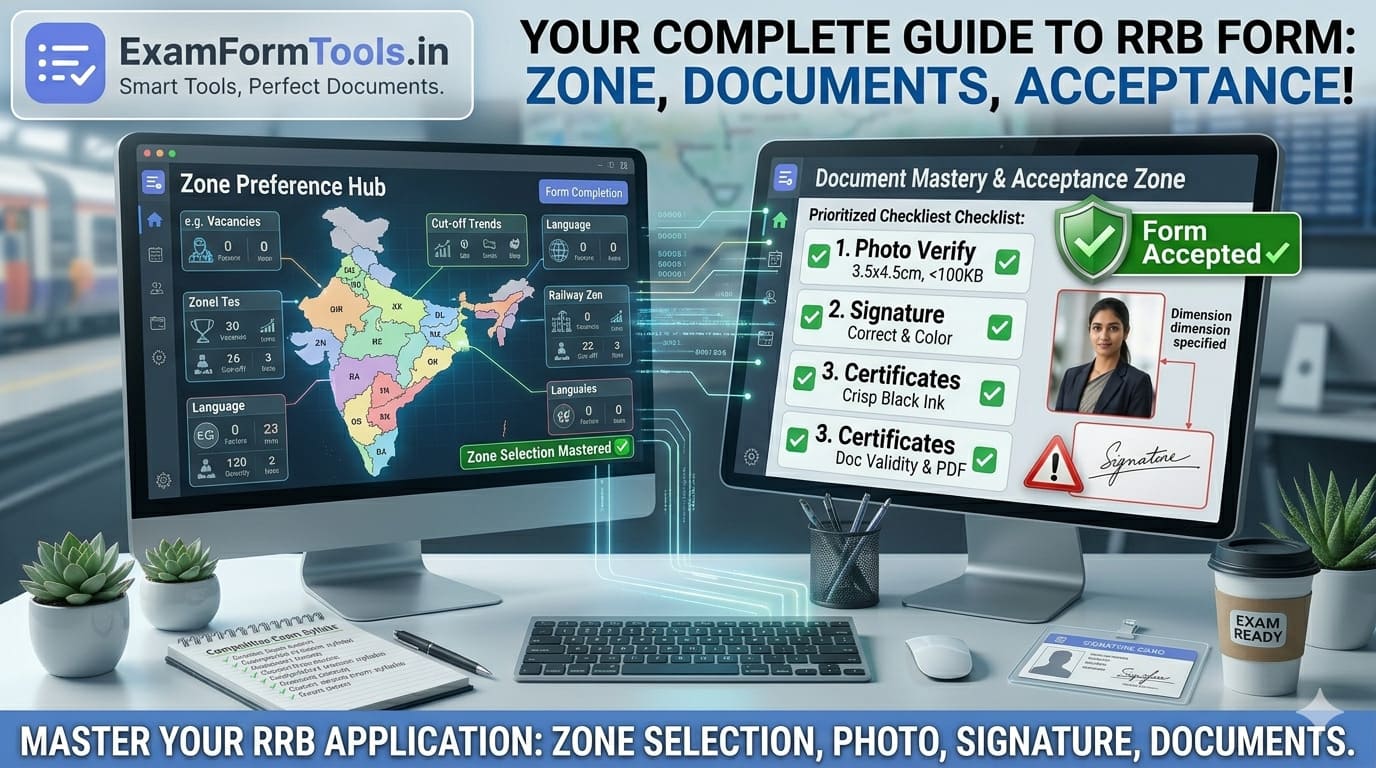
Railway recruitment is different from other government exams in one significant way: the sheer scale. When RRB notifications come out, whether it’s NTPC, Group D, JE, or ALP, lakhs of candidates apply within days. I’ve seen portals crash under the load, payment gateways timeout during peak hours, and students who prepared for months get stuck on technical glitches during submission.
But here’s what I’ve also seen: candidates who apply strategically, with careful zone preference planning and proper documentation, sail through not just the application process but also the later document verification stages without any hiccups.
RRB recruitment cycles attract huge participation, and that makes form quality non-negotiable. Candidates who apply randomly, picking zones based on rumors or choosing preferences without understanding implications, often lose opportunities due to preference mistakes or documentation gaps discovered months later during verification.
This guide helps you apply with strategy, not guesswork. Let’s make sure your application is one that gets through smoothly.
Understanding RRB Zone System: The Foundation of Smart Application
Before we even talk about filling forms, you need to understand how RRB zones work, because this affects your entire application strategy.
Indian Railways has 17 zones, and each zone has its Railway Recruitment Board (or sometimes multiple boards within a zone). When you apply for positions like NTPC, Group D, or ALP, you’re not just applying to “Indian Railways” as a generic entity. You’re applying to specific RRBs, and your preference order matters significantly.
Here’s what many candidates don’t realize: your zone preference isn’t just about where you’ll write the exam (that’s usually region-based and has multiple centers). It’s about where you might eventually be posted for training and deployment.
For some RRB exams, your preference order directly influences your posting allocation if you qualify. For others, it affects which RRB will handle your document verification and further process. Either way, it’s not a cosmetic choice you make randomly.
Zone and Post Preference Planning: The Strategic Approach
Let me share a real scenario. Two students from Delhi both qualified for RRB NTPC. Student A had put Eastern Railway (Kolkata) as first preference because “I heard they have more vacancies.” Student B put Northern Railway (Delhi) as first preference because “I analyzed vacancy trends for my category over the last three cycles, and Northern Railway consistently has good intake for my qualification.”
Student A got allocated to Eastern Railway, which meant relocating to Kolkata for training and likely posting somewhere in the eastern zone (West Bengal, Bihar, Jharkhand region). The relocation cost, language barrier, and distance from family became stress factors he hadn’t considered during application.
Student B got allocated to Northern Railway, which meant training and likely posting within the northern zone (Delhi, UP, Punjab, Haryana region), closer to home, familiar territory, and manageable logistics.
Both qualified. Both got jobs. But one had strategically planned his application, and the other was dealing with consequences he hadn’t anticipated.
Before you fill your zone preferences, do this homework:
Step 1: Study Vacancy Trends Zone-Wise for Your Category
RRB releases detailed vacancy breakdowns in the official notification. Don’t just look at total vacancies. Break it down by:
- Your category (UR/SC/ST/OBC/EWS): A zone might have 500 total vacancies, but if you’re OBC and only 50 of those are OBC vacancies, that’s your relevant number.
- Your post preference: If you’re applying for multiple posts (like in NTPC where you can apply for graduate-level and undergraduate-level posts), check which zones have more vacancies for your preferred post.
- Your qualification: Some zones have more vacancies for specific educational qualifications. If you’re a B.Tech applicant, check which zones have higher technical post vacancies.
Where do you find this data? In the official notification PDF, usually in annexures or vacancy distribution tables. Take time to read those tables carefully. Make a spreadsheet if needed. Comparing 17 zones across multiple parameters is easier when you organize the data.
Step 2: Check Language and Regional Requirements
This is particularly important for posts that involve customer interaction or region-specific operations.
Indian Railways is divided into zones based on geographical regions, and some zones have language preferences or requirements. For example:
- Eastern Railway, South Eastern Railway: Regions where Bengali, Odia might be advantageous for ground-level roles
- Southern Railway, South Western Railway: Regions where Tamil, Telugu, Kannada, Malayalam are commonly spoken
- Northern Railway: Hindi and English are predominantly sufficient
- North Eastern zones: Where Assamese and regional dialects are common
Now, for most posts, especially technical and non-customer-facing roles, language isn’t a strict requirement. But it’s a practical consideration. If you don’t speak the regional language and get posted to a station in rural Tamil Nadu or rural West Bengal, your daily work life will have an adjustment curve.
I know people who managed fine without local language knowledge, but I also know people who struggled. Consider your own adaptability and willingness to learn a new language if you’re prioritizing a zone based purely on vacancy numbers.
Step 3: Assess Posting Flexibility and Travel Constraints
Be realistic about your life situation. Ask yourself:
Can you relocate anywhere in India if required? If yes, you have maximum flexibility and can prioritize purely based on vacancies and career growth. If no, you need to factor in which zones are acceptable for you.
Do you have family responsibilities that limit relocation? If you’re the primary caregiver for elderly parents, or you have young children whose education you don’t want to disrupt, or you have medical considerations that require you to be near specific cities, factor that into your zone preferences.
What’s your financial capacity for relocation? Relocating to a different zone for training and posting involves costs: travel, temporary accommodation during training, eventually moving household if it’s a long-term posting. Some zones are more expensive (metros like Mumbai, Delhi, Bangalore) than others. If you’re from a smaller town and get posted to Mumbai, the cost-of-living difference is significant.
What about spouse employment if you’re married or planning to get married? If you’re single, this might not matter now, but think ahead. If you marry someone with a job in a specific city, getting posted to a zone far from that city creates dual-career logistical challenges.
These aren’t pessimistic considerations. They’re realistic planning. You’re applying for a long-term career, not a short-term project.
Step 4: Order Preferences Realistically Based on All Factors
Now combine everything: vacancy numbers, language comfort, relocation feasibility, family situation, financial considerations.
Create a preference order that balances opportunity with practicality.
A common mistake: ordering zones purely by vacancy numbers without considering practicality. Yes, a zone might have 1000 vacancies, but if it’s geographically and personally unmanageable for you, and you eventually decline the posting or struggle there, the high vacancy number didn’t help.
A smarter approach: identify 3-5 zones that are practically manageable for you, then order those based on vacancy trends and career prospects.
Preference order is not cosmetic. It can influence allocation outcomes. RRB algorithms use your preference order during allocation. If two candidates have similar scores and both are eligible for a vacancy, preference order can be a tie-breaker. Don’t treat it casually.
Upload-Ready Document Set: Preparing Before You Open the Portal
Let’s talk documentation. RRB is particularly strict about document verification, and that verification happens after CBT stages when you’ve invested months of preparation. Getting rejected at document verification stage due to a certificate problem is heartbreaking and avoidable.
Here’s what you need, organized and ready, before you even open the application portal:
Essential Documents for All Applicants
Recent passport-sized photograph: Within the last 3 months. Same photo that you’ll use throughout the process. Color photograph, plain light background, clear face visibility. Keep both digital copy (for upload) and physical copies (for later stages like document verification). The digital file should meet RRB specifications (usually 20-50 KB, specific pixel dimensions, JPEG format).
Signature image: On white paper, dark ink (blue or black as specified), scanned or photographed clearly. Your signature should be consistent because you’ll sign attendance sheets during exams and documents during verification. If your uploaded signature and actual signature look dramatically different, it creates verification problems.
Educational qualification certificates: Depending on the post you’re applying for:
- For 10th pass posts: Class 10 marksheet and certificate
- For 12th pass posts: Class 10 and Class 12 marksheets and certificates
- For graduate posts: Class 10, 12, and Degree certificates with all semester marksheets
- For ITI posts: ITI certificate with NCVT/SCVT registration number clearly visible
- For diploma posts: Diploma certificate with semester marksheets
Keep digital scans ready. PDF format, compressed to within size limits (usually 100-200 KB per document), but ensure text remains readable. Don’t compress so much that certificate text becomes blurry.
Date of Birth proof: Usually Class 10 certificate serves this purpose, but some notifications might ask for birth certificate if there’s any discrepancy. Check the notification carefully.
Community/Category certificate (if applicable): This is where many candidates make mistakes. Let me elaborate in the next section.
PwD certificate (if applicable): Issued by competent medical board, with clear disability percentage and type mentioned.
Category Certificate Discipline: Getting This Right is Critical
For reserved category applicants (SC, ST, OBC, EWS, PwD), your category certificate is not just a formality. It’s a document that will be scrutinized at multiple stages: during application, during document verification, during medical examination, and during joining.
For SC/ST candidates:
The certificate should be issued by a competent authority as specified by your state government. Usually, it’s the SDM, Tehsildar, or District Magistrate. It should clearly mention:
- Your name (matching exactly with your educational certificates)
- Your father’s/mother’s name
- Your caste name
- Clear statement that your caste is recognized as SC or ST under the Constitution
- Issuing authority’s signature, seal, and date
SC/ST certificates generally don’t have validity periods, but the certificate should be issued within a reasonable timeframe. If you have a certificate from 10 years ago and your name or other details have changed (due to marriage, for example), get a fresh certificate.
For OBC-NCL (Non-Creamy Layer) candidates:
This is where most confusion and rejections happen. OBC-NCL certificate has strict validity rules.
The certificate must be issued within the current financial year (April to March). If you’re applying for RRB in December 2025, your OBC-NCL certificate should be issued on or after April 1, 2025. A certificate from March 2025 will be invalid.
It must clearly state “Non-Creamy Layer” status. A certificate that just says “OBC” without specifying NCL is not sufficient.
It should be issued by competent authority: usually District Magistrate, SDM, Tehsildar, or equivalent as per your state rules.
For EWS (Economically Weaker Section) candidates:
EWS certificate also has financial year validity. It should be issued for the current financial year based on income criteria.
The income limit and asset criteria are specified by the government (currently annual income less than ₹8 lakh and asset criteria). Your certificate should confirm you meet these criteria.
EWS certificates are relatively new (introduced in 2019), so formats vary across states. Ensure your certificate follows the central government format or the format accepted by RRB as per the notification.
Common category certificate mistakes to avoid:
- Using expired certificates: Especially for OBC-NCL and EWS where validity periods are strict
- Name mismatch: Your name on category certificate should exactly match your educational certificates. “Rajesh Kumar Singh” on degree but “R.K. Singh” on caste certificate creates problems
- Incomplete certificates: Missing issuing authority seal, missing date, missing registration number
- Certificates issued by wrong authority: Check the notification for who is the competent authority for your state
- Using certificates in wrong language: Some states issue certificates in regional languages. If RRB asks for English/Hindi certificate and you upload a Tamil or Bengali certificate without translation, it might get rejected
Pro tip: Get your category certificate issued well before the application notification comes out. Don’t wait until the last week of application to approach the SDM office. Government offices have processing times, and if your certificate has any error or missing detail, you’ll need time to get it corrected.
Use Clear File Names to Avoid Upload Confusion
This sounds trivial, but it prevents real mistakes.
When you have 8-10 PDF files to upload (photo, signature, Class 10 marksheet, Class 12 marksheet, degree, caste certificate, EWS certificate, etc.), naming them clearly prevents uploading the wrong file in the wrong field.
Instead of generic names like “Document1.pdf”, “Scan0023.pdf”, use names like:
- “RRB_Photo_YourName.jpg”
- “RRB_Signature_YourName.jpg”
- “RRB_Class10_Marksheet.pdf”
- “RRB_Degree_Certificate.pdf”
- “RRB_OBC_NCL_Certificate_2026.pdf”
When you’re uploading at 11 PM on deadline day (which, let’s face it, many of us do), clear file names save you from uploading your degree certificate in the Class 10 marksheet field and discovering the mistake a week later.
Keep Data Consistent Across All Stages: The Long-Term View
RRB recruitment is not a one-time form submission. It’s a multi-stage process that can span 6 months to over a year from application to joining. Your data needs to remain consistent throughout.
Here’s the typical RRB process flow:
- Application submission: You enter details and upload documents
- CBT (Computer Based Test) Stage 1: You appear for the exam, your admit card has details printed
- CBT Stage 2 (if applicable): Another exam round, another admit card with details
- Skill Test/Typing Test (where applicable): For posts like clerk, stenographer, etc., another stage with documents
- Document Verification: You physically appear with original certificates
- Medical Examination: You undergo medical tests, documents are checked again
- Final Merit List and Offer: Posting allocation happens
- Joining: You submit documents again to the appointing authority
At each of these stages, your identity details (name, father’s name, date of birth), category details, and qualification details are checked and cross-verified.
If you entered your name as “Amit Kumar” in the application but your Class 10 certificate says “Amit Kumar Sharma” and your degree says “A.K. Sharma”, this inconsistency will create problems at document verification.
How to maintain consistency:
Use your full name as it appears on Class 10 certificate everywhere. This is your official identity for RRB purposes. Don’t use short names, nicknames, or initials unless your official certificates use them.
Father’s name and mother’s name should be consistent across all certificates. If there are variations (like some certificates have full name and others have initials), bring supporting documents (like affidavit or gazette notification if there’s been a name change) to document verification.
Date of birth should match across all documents. Usually, Class 10 certificate is the primary DOB proof. If any other certificate has a different DOB due to an error, get it corrected before applying, or be ready to explain with supporting documents.
Category should be consistently claimed. If you applied as OBC-NCL, you should have valid OBC-NCL certificate at every stage. You can’t apply as OBC and then show up at document verification with a different category certificate.
Qualification details should match uploaded certificates. If you claimed “B.Tech in Computer Science” in the application, your degree should say the same. If you wrote “B.E. in Information Technology”, that’s a discrepancy you’ll need to explain.
I know this sounds like common sense, but under application stress, students make these errors. Taking 15 minutes to verify consistency before submission saves hours of explanation and stress later.
Practical Submission Timeline: The Week-by-Week Approach
RRB notifications usually give 30-40 days for application submission. Here’s how to use that time smartly instead of doing everything on the last day.
Week 1: Document Collection and Verification Phase
- Read the official notification PDF completely. Not a quick skim. Read every section, especially eligibility criteria, age limits, educational qualifications, reserved category provisions, and application process instructions.
- Collect all required certificates. Pull them out from wherever you’ve stored them. Make a checklist and tick off each document as you gather it.
- Verify certificate details. Check that names are consistent, dates are correct, seals and signatures are present. If you spot any issue, you have time to get corrections.
- Get category certificate issued if you don’t have a valid current one. Remember, OBC-NCL and EWS need to be current financial year.
- Get fresh photographs clicked if needed. Go to a studio that handles government document photos regularly. Tell them it’s for RRB, they’ll know the specifications.
- Prepare signature and scan/photograph it properly.
Week 2: Digital File Preparation Phase
- Scan all certificates at good quality (200 DPI minimum). Save original high-quality scans.
- Compress PDFs to within RRB size limits while maintaining readability. Test by opening on different devices and zooming to 100%.
- Prepare photo file to exact specifications (dimensions, file size, format). Test upload on some random website to see if file is not corrupted.
- Prepare signature file similarly.
- Organize everything in a clearly labeled folder.
- Create a text file or note with all data you’ll need during form filling: Class 10 details (board name, roll number, passing year, percentage), Class 12 details, degree details, category certificate details (certificate number, issuing authority, date), etc. Having this ready means you’re not hunting for certificates while filling the form.
Week 3: Form Filling and Review Phase
- Choose a time when you’re not rushed or tired. Mid-morning or early evening works for most people.
- Open the RRB portal, register if it’s a new recruitment, log in if you already have credentials.
- Fill the form section by section. Don’t rush. Refer to your organized notes and certificates.
- Pay special attention to zone preferences. Order them thoughtfully based on your analysis.
- Upload documents carefully. Verify each upload shows correctly in the preview.
- Save as draft after completing.
- Take a break for a few hours or a day.
- Return with fresh eyes. Review every field. Compare with certificates. Check uploads.
- Do a final verification pass with a parent or friend. A second pair of eyes catches errors you missed.
Week 4: Submission, Payment, and Backup Phase
- Complete payment. Use a stable internet connection. Avoid peak hours if possible (early morning or late night usually have lower traffic).
- Submit the application.
- Download confirmation page immediately. Take screenshots of application number and payment confirmation.
- Save confirmation PDF in multiple locations: email it to yourself, save to cloud storage, save on computer, save on phone, print a physical copy.
- Within 24 hours of submission, log in again and verify that your application is showing as “submitted” and payment is showing as “success”.
- Note down important dates: exam date (when announced), document verification dates (announced after results), and any other dates mentioned in the notification.
This timeline assumes you’re applying with 3 weeks to spare before deadline. If you’re starting later, compress the phases but don’t skip verification steps.
Zone Preference Decision Framework: Detailed Tie-Breaker Logic
Let me give you a practical decision framework for when you’re torn between two zones that seem equally good.
Scenario: You’re analyzing Central Railway (Mumbai) vs Northern Railway (Delhi) for RRB NTPC. Both have similar vacancy numbers for your category. Both are major zones with good career prospects. Which do you prefer?
Use this tie-breaker checklist:
Factor 1: Vacancy stability across recent cycles.
Go beyond just the current notification. Check the last 2-3 RRB NTPC/Group D cycles. Has this zone consistently had good vacancies, or was this an anomaly? Consistent high recruitment indicates stable organizational expansion and better long-term career prospects.
Where to find this data? Previous notification PDFs are usually available on RRB websites. You might need to dig through archives or use web.archive.org if they’ve been removed.
Factor 2: Travel and relocation cost impact.
Calculate rough costs. If you’re from Jaipur:
- Relocating to Delhi (Northern Railway) might cost ₹10,000-15,000 for initial move, moderate accommodation costs
- Relocating to Mumbai (Central Railway) might cost ₹20,000-25,000 for initial move, significantly higher accommodation costs during training and later
If you’re selected and need to join within a month, can you afford the higher relocation cost? Do you have family support in either city that can ease the transition?
Factor 3: Language comfort for long-term posting.
Northern Railway: Hindi and English predominantly sufficient. If you’re from North India, culturally and linguistically familiar territory. Central Railway: Marathi is widely spoken in Maharashtra region. Hindi and English work in Mumbai, but if you get posted to a smaller station in Maharashtra, basic Marathi helps.
Assess your language adaptability honestly. Some people pick up languages easily, others struggle. If you’re not comfortable with the idea of learning a new regional language, factor that in.
Factor 4: Family or support network proximity during training period.
Training periods can be 6 months to a year. Having family nearby or even in the same city provides emotional support, reduces costs (you can stay with family instead of paying for accommodation), and makes the transition easier.
If you have relatives in Mumbai but none in Delhi, that’s a practical consideration. If you have friends from college settled in Delhi who can help you navigate the initial days, that matters.
Factor 5: Future life planning (marriage, children’s education, spouse career).
Think 5-10 years ahead. If you get posted to a zone:
- How easy is it to find good schools for children in that region?
- If your spouse is working or will work, how feasible is it for them to find employment in that zone?
- Are you comfortable raising a family in that region long-term?
These aren’t questions you can answer definitively at 22-23 years old, but having a directional sense helps. If you absolutely cannot imagine living in a particular region long-term, don’t prioritize that zone just for a marginal vacancy advantage.
Weigh all factors, not just one:
Create a simple scoring system if it helps. Assign points to each zone based on these factors, then order by total score. It’s not a perfect science, but it’s better than random selection or going purely by hearsay.
A thoughtful preference order usually performs better than selecting purely by rumor or first-come-first-served zone selection.
Final Verification Before Locking Form: The Point of No Return Checklist
This is your last chance to catch errors before submission. Once you submit and the edit window closes (if there even is one), errors are hard to fix.
Do not submit until you’ve confirmed these items:
Checklist Item 1: Name and Birth Date Exactly Match Certificates
Pull out your Class 10 certificate physically. Compare character by character:
- First name spelling
- Middle name (if any)
- Surname spelling
- Spacing (some certificates have extra spaces that matter for exact matching)
- Date of birth in DD/MM/YYYY format
Even a small difference like “Suresh” vs “Sures” or “01/05/1998” vs “1/5/1998” can create database matching issues.
Checklist Item 2: Category Details Supported by Valid Documents
If you selected “OBC-NCL”:
- Do you have an OBC-NCL certificate? (not just OBC, it must say NCL)
- Is it issued in the current financial year?
- Does the name on the certificate match your other certificates?
If you selected “EWS”:
- Do you have an EWS certificate for current financial year?
- Does it mention income and asset details as per norms?
If you selected “PwD”:
- Do you have a disability certificate from competent medical board?
- Does it mention the disability percentage and type clearly?
If you can’t confidently answer yes to these, either get the correct certificate or apply under General category. Claiming a category without proper certificate leads to rejection at verification stage after you’ve invested months of preparation.
Checklist Item 3: Uploaded Files Open and Display Correctly on Another Device
This is a critical technical check. Sometimes files upload corrupted or display incorrectly.
After uploading all documents:
- Download the preview/confirmation PDF that RRB generates
- Open it on a different device (if you uploaded on laptop, check on phone; if you uploaded on phone, check on laptop)
- Zoom to 100% and verify all uploaded images and PDFs are clear and readable
- Check that photo is showing correctly, signature is showing correctly, certificates are legible
If preview PDF is not generated during application, at least check the upload preview on the portal itself from different browsers or devices.
Checklist Item 4: Payment Success Reflects in Candidate Dashboard
After you complete payment:
- Don’t just trust the payment gateway success message
- Log in to your RRB candidate dashboard
- Check that payment status shows “Success” or “Completed” or “Payment Received”
- If it shows “Pending” or “Processing”, wait for 2-4 hours and check again
- Only when dashboard confirms payment success should you consider it complete
I’ve seen cases where payment gateway showed success, but due to technical issues, payment didn’t register on RRB side. Catching this early (within 24-48 hours) allows you to contact support or make a fresh payment attempt if needed.
Checklist Item 5: Zone Preferences Are in Correct Priority Order
Review your zone preference list one more time. You ordered them based on your analysis, but double-check:
- First preference is truly your top choice
- Order is correct (1, 2, 3… not accidentally jumbled)
- You didn’t accidentally skip a preference number
- You used all available preference slots strategically (if RRB allows 5 preferences, use all 5, don’t leave blank)
Common RRB Application Mistakes and How to Avoid Them
Let me share some real mistakes I’ve seen across multiple RRB cycles:
Mistake 1: Choosing “ITI” as qualification when you have a Diploma.
RRB often has different posts for ITI holders and Diploma holders. They’re not interchangeable. If you have a Diploma in Engineering but select ITI posts thinking “it’s similar”, you’ll be rejected. Similarly, if you have ITI but apply for Diploma posts, you’re ineligible. Check qualification requirements carefully for each post.
Mistake 2: Entering wrong community/category registration number.
Some states issue registration numbers with caste certificates (like in Tamil Nadu, community certificates have a registration number). If the form asks for this and you enter it wrong or leave it blank when you should fill it, it creates verification issues. Check your certificate and enter exactly.
Mistake 3: Uploading blurry or incorrectly cropped photo.
RRB is strict about photo quality because they print it on admit cards, and exam center staff use it for identification. A blurry photo or oddly cropped photo (where half your head is cut off or too much white space around you) gets rejected. Get it done professionally if you’re not confident about quality.
Mistake 4: Not checking email and mobile number validity.
Some students enter an email they created years ago and don’t use anymore, or a mobile number that’s their parent’s but the parent doesn’t reliably forward messages. You’ll receive exam city intimation, admit card download links, result announcements on this email and mobile. Use ones you actively access.
Mistake 5: Selecting exam center city without checking travel feasibility.
RRB asks you to select exam city preferences. Don’t just pick the nearest city without checking travel logistics. If you select a city that requires overnight travel and the exam is early morning, you’ll need accommodation. Factor in costs and logistics.
Post-Submission Strategy: What to Do While Waiting for Exam
You’ve submitted successfully. Payment is confirmed. Confirmation PDF is saved. Now what?
Week 1-2 after submission:
Monitor your email and RRB portal regularly. Download and save any acknowledgment or additional documents the portal generates. Some RRBs issue a separate application status sheet after scrutiny; download it when available.
If there’s an edit window (some RRBs provide 2-3 days for editing after initial submission), use it only if you genuinely need to correct an error. Don’t make unnecessary changes.
Weeks 3-4:
Keep checking the official RRB website for updates on exam city allocation, exam date announcement, and important notices. Add the RRB website to your bookmarks and check weekly.
4-8 weeks (or longer depending on the cycle):
Exam city intimation gets released. This tells you which city you’ll be writing the exam in. Download and save this document.
2-3 weeks before exam:
Admit card download opens. Download immediately when it opens (first few days have heavy traffic, so try during off-peak hours if the site is slow). Print 2-3 copies. Verify all details on admit card. Check exam center address, exam date and shift, your personal details, photo and signature printing quality.
If you notice any critical error on admit card (wrong name, wrong category, photo not printed clearly), contact RRB helpline immediately with your application number and details. Don’t wait until exam day.
During the waiting period, focus on exam preparation:
The application is done. Don’t obsess over whether your photo will be accepted or whether you filled zone preference correctly. You’ve done your due diligence. Now shift mental energy to preparation.
For CBT, you need to prepare:
- Quantitative aptitude and reasoning (for most RRB exams)
- General awareness and current affairs
- Technical subjects if applicable (for JE, ALP, etc.)
Use the waiting period productively. Solve previous year papers, take mock tests, strengthen weak areas.
Final Thoughts: Process-Heavy Doesn’t Mean Process-Impossible
RRB is process-heavy, I won’t sugar-coat that. It’s a large, bureaucratic system handling lakhs of applications. There are rules, formats, document requirements, and verification stages.
But process-heavy doesn’t mean process-impossible. It means you need to be systematic, organized, and attentive to details.
Candidates who prepare documents early, who read notifications carefully, who verify their applications thoroughly, and who maintain consistency across stages usually navigate RRB recruitment smoothly.
The students who struggle are often the ones who applied casually, who didn’t have proper documents ready, who ignored small errors thinking “they won’t check so strictly”, who picked zone preferences randomly based on rumors.
Don’t be the second type. Be the first type.
Use this guide as a checklist. Follow it step by step. Take your time during application. Verify twice before submitting once.
Railway jobs are stable, respectable, and offer good career progression. The application process is your gateway to that career. Walk through it carefully, methodically, and confidently.
Prepare your documents early. Apply with strategy. Verify thoroughly. Submit confidently. Then focus on your preparation and perform well in the exam.
That’s the approach that works for RRB. That’s how you set yourself up for success from the very first step.
All the best for your RRB journey. Apply smart, prepare hard, and may you get your preferred zone and post.