Government Job Form Cyber Safety: How to Avoid Fake Portals, Payment Frauds, and Data Leaks
A practical cyber safety guide for exam applicants covering fake portal detection, secure payment habits, and sensitive document protection.
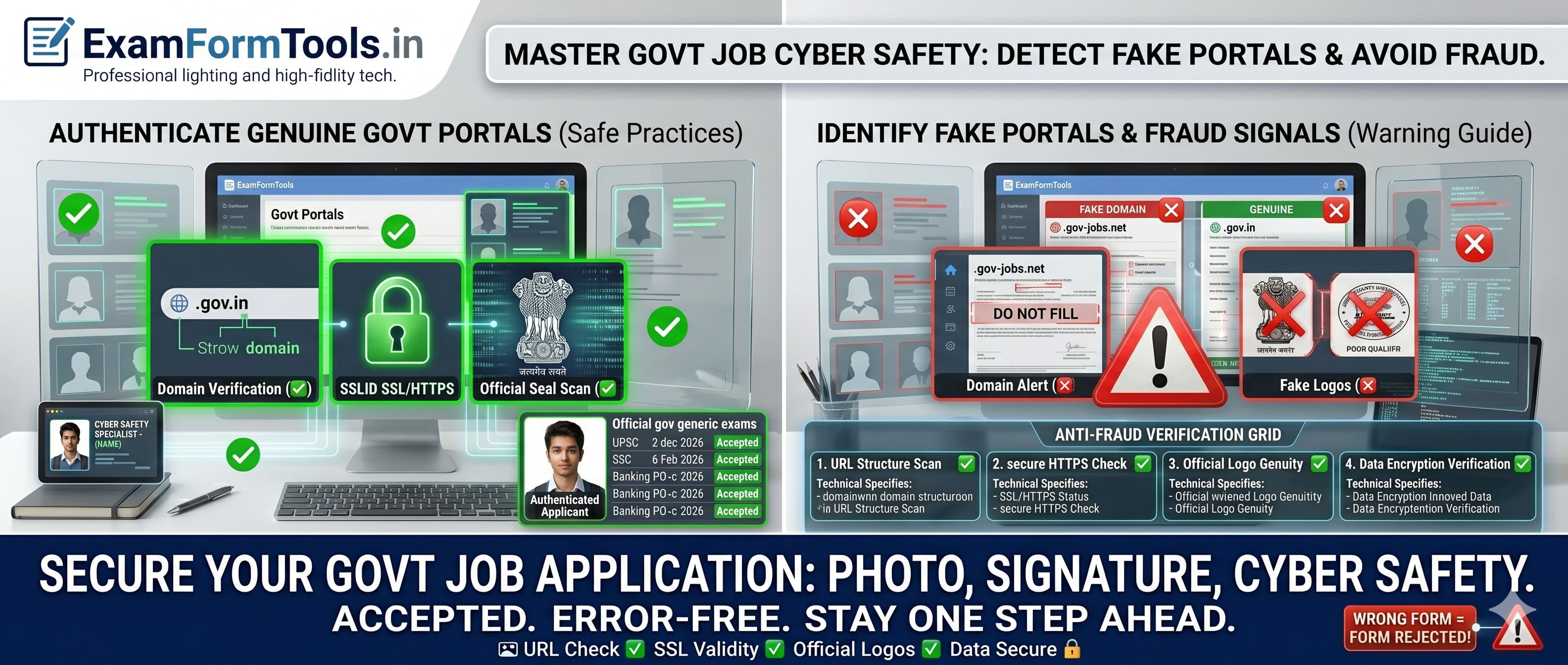
As online applications have expanded, scam attempts have become more aggressive. Applicants are now targeted through fake domains, cloned payment pages, and social-engineering calls. Last month, a friend of mine lost 15,000 rupees to what looked like a perfectly legitimate SSC application portal. The website design was flawless. The language was professional. Even the payment gateway looked authentic. It was only after the money disappeared and the site went offline that he realized he’d been scammed.
Stories like this aren’t rare anymore. They’re becoming disturbingly common. With lakhs of candidates applying for competitive exams every season, cybercriminals have found a goldmine. They know applicants are stressed, time-pressured, and desperate not to miss deadlines. They exploit these emotions ruthlessly.
Digital caution is no longer optional. It’s survival.
How Fake Portals Usually Look (They’re Getting Scarily Good)
The fake portals of 2026 aren’t the obvious scams of five years ago. Back then, you could spot them from a mile away—broken English, garish designs, suspicious URLs. Today’s scammers are sophisticated. They study official websites, clone them pixel-perfect, and even buy domains that are one letter different from the real ones.
Let me walk you through what happened to Meera, a UPSC aspirant from Jaipur. She was searching for the official application link on Google one evening. The first result looked perfect: clean design, official-looking logo, even had an HTTPS lock symbol in the browser. She clicked through, filled half the form, and only paused when the site asked for payment before she’d even uploaded documents. Something felt off. She checked the URL carefully. Instead of upsc.gov.in, it was upsc-gov.in. One tiny hyphen made all the difference.
Watch for these warning signs that separate real portals from dangerous fakes:
Domain names with extra letters or unusual suffixes: Official government portals in India end with .gov.in, .nic.in, or occasionally .ac.in for educational institutions. Anything else—.com, .org, .in, .net—should immediately raise suspicion. Scammers register domains like ssc-nic.in, ibps-recruitment.org, or railway-rrb.com. They look official at first glance but aren’t government domains.
Here’s a practical check: before entering any information, look at the URL in your browser’s address bar. Not just the visible text, but the actual domain. Some scammers use display tricks to show one URL while the actual address is different. Right-click and “copy link address” to see the real URL.
Countdown popups that force instant payment: This is psychological manipulation 101. “Only 47 minutes left to apply!” or “5 slots remaining for this exam!” These create artificial urgency to make you act without thinking. Real government portals give you clear deadlines—dates and times, not countdown timers. They don’t need to pressure you. The deadline is the deadline.
I’ve seen fake portals with “live applicant counters” showing numbers climbing rapidly to create panic. “8,547 candidates applied in the last hour!” Real portals don’t do this. They want careful, accurate applications, not rushed ones.
Unofficial contact emails or poor language quality: Check the contact information. Official portals list phone numbers that start with proper area codes, email addresses from government domains, and physical addresses of commission offices. Fake portals often use Gmail, Yahoo, or Outlook addresses. One scam site I investigated had a contact email like “[email protected].” No government body uses free email services for official communication.
Language quality has improved in fake portals, but it’s not perfect. Look for inconsistent terminology. Official notifications use specific technical language consistently. Fakes often mix casual and formal tone, use incorrect technical terms, or have subtle grammar issues that a government editor would catch.
Claims like guaranteed selection or paid shortlist: This should be obvious, but desperation makes people overlook red flags. Any portal promising “guaranteed selection for ₹50,000” or “shortlist your application for ₹5,000” is a scam. Period. Government selections are merit-based. Nobody can guarantee anything, and certainly not for money.
Some sophisticated scams offer “application review services” or “priority processing” for a fee. These sound more legitimate but are equally fraudulent. There’s no such thing as priority processing in government exams. Every application goes through the same process.
The verification ritual I follow (and recommend):
Before clicking any application link, I do this three-step check:
- Go to the official website directly by typing the URL I’ve verified before (I keep a bookmark folder of genuine portals)
- Navigate to the application link from within the official site’s menu
- Double-check the URL after clicking to ensure I haven’t been redirected
Never trust Google search results blindly. Scammers pay for ads that appear above genuine results. Never trust links shared in WhatsApp groups without verification. Even well-meaning people can accidentally share fake links.
Safe Payment Habits (Your Money Deserves Better Protection)
Payment fraud in exam applications happens at the most vulnerable moment—when you’ve spent an hour filling the form, you’re emotionally invested, and you just want to finish. That’s when scammers strike.
Rajesh’s story still makes me angry. He was applying for RRB NTPC, almost done with the application, when the portal directed him to a payment page. It looked exactly like the government payment gateway he’d used before. He entered his card details, received an “error” message, tried again, another error, tried a third time. Only when he checked his bank statements later did he realize each “failed” transaction had actually gone through—to a scammer’s account. Three payments of ₹590 each, gone.
Here’s how to protect yourself:
Pay only inside official portal flow: Never click external payment links sent via email, SMS, or WhatsApp. Even if they claim to be from the exam authority. Legitimate payment always happens within the application portal itself. You log in, fill your form, and the portal redirects you to the payment gateway. Any deviation from this flow is suspicious.
The official payment gateway URL for government exams in India typically includes sbicollect.com, billdesk.com, or similar verified payment aggregators. Before entering card details, verify the payment gateway’s URL. Look for the security certificate (click the lock icon in your browser). Check that the company name matches a known payment processor.
Never share OTP with anyone: This seems obvious, yet people fall for it constantly. Here’s how the scam works: You’ve just completed payment, you’re waiting for confirmation, and you receive a call. “Sir, I’m calling from the exam helpdesk. Your payment is stuck. To release it, please share the OTP you’ll receive in the next few seconds.”
It sounds urgent. It sounds official. It’s a complete scam.
No legitimate organization will ever, EVER ask for your OTP. Not the bank. Not the payment gateway. Not the exam authority. Not the technical support team. The OTP is for YOUR authentication only. Sharing it is like handing over your debit card and PIN together.
If someone calls asking for OTP, hang up. Don’t argue, don’t explain, just disconnect. Then verify your payment status by logging into the portal directly (not through any link they might send).
Ignore QR payment requests from unknown contacts: A new scam variant I’ve seen recently involves WhatsApp messages claiming to be from exam authorities. “Your application has a documentation issue. Pay ₹500 verification fee via this QR code to proceed.” Sometimes they impersonate coaching centers or fellow aspirants “helping” you.
QR codes can be payment collection requests or data-stealing tools. Don’t scan any QR code related to exam applications unless you’re absolutely certain of its source. And even then, verify through official channels first.
Save transaction reference immediately: The moment a payment succeeds, take a screenshot of the transaction confirmation page. Note down the transaction ID, date, time, and amount. Don’t rely on email confirmations alone—sometimes scam sites send fake confirmation emails that look real but have no actual transaction backing them.
Store these screenshots in a dedicated folder, named with the exam and date. If any payment dispute arises, this is your proof. I maintain a simple log:
Transaction_Log.txt
SSC CGL 2026 - Trans ID: SBIC20260315001234 - ₹590 - 15 March 2026, 3:45 PM - SUCCESS
UPSC CSE 2026 - Trans ID: BILL20260318005678 - ₹100 - 18 March 2026, 11:20 AM - SUCCESS
If payment fails, follow official support channels only: Payment failures happen. Servers crash during peak application times. Payment gateways timeout. Banks decline transactions for security reasons. It’s frustrating, but it happens.
When it does, resist the urge to search for “quick solutions” online. Don’t call random helpline numbers found through Google. Don’t email addresses that aren’t listed on the official notification.
Official support channels are mentioned in the notification document. Usually, there’s a helpdesk email and phone number. Contact only these. Explain your issue clearly: application ID, transaction ID (if any), time of attempt, error message received. Attach screenshots.
Yes, official support can be slow. You might wait hours or even days for a response. But it’s safer than the alternative, which is falling for a fake support scam that charges you for “resolving” an issue that resolves itself.
Protect Your Uploaded Documents (Your Data Is Worth More Than You Think)
Your exam application files—photo, signature, certificates, ID proof—contain valuable personal information. Full name, father’s name, date of birth, address, identification numbers. In the wrong hands, this data enables identity theft, financial fraud, or targeted scams.
I learned this lesson the hard way. A few years ago, I was active in an exam preparation Telegram group. Someone asked for help with photo resizing, and I helpfully uploaded my own passport photo as an example of correct dimensions. A week later, I received a call from a “bank verification officer” who knew my full name, my father’s name, and my current city. They were attempting a KYC update scam. I realized they’d harvested my information from that innocent group photo upload.
Use password-protected folders: Store all exam-related documents in encrypted folders. Windows has built-in folder encryption, and macOS has encrypted disk images. Use them. If your laptop is stolen or accessed by someone else, your documents remain secure.
Create a strong password that’s not your birthdate, phone number, or any easily guessable pattern. Use a passphrase—a random combination of four or five unrelated words, like “purple-bicycle-monsoon-library-47.” Long, random, and memorable.
Do not share full documents in public groups: Exam aspirants often help each other with formatting questions. “How should my signature look?” “Is my photo’s background acceptable?” These are genuine queries, but sharing full documents publicly is dangerous.
If you must share for help, crop the document to show only the relevant part. If you’re asking about signature quality, crop out everything except the signature. If you’re checking photo dimensions, obscure your face or use a different photo altogether for demonstration.
Better yet, ask someone you trust personally, via private message, not in public groups with thousands of unknown members.
Mask unnecessary personal data when asking for help: Sometimes you need to share a document for troubleshooting—maybe a file is getting rejected and you need to check formatting. Before sharing, use an image editor to mask sensitive information.
Black out your name, father’s name, dates, identification numbers, addresses. Show only what’s necessary for the question. If you’re asking about file size, the actual content doesn’t matter. If you’re asking about image quality, personal details are irrelevant.
I use a simple photo editing app on my phone to draw black rectangles over sensitive parts before sharing anything online. Takes 30 seconds, prevents years of potential problems.
Delete temporary scans from phone gallery: Many people scan documents using phone camera apps or dedicated scanner apps. These scans get saved to your phone’s gallery automatically. If you’re not careful, they sync to cloud storage, get included in automatic backups, or remain accessible if your phone is lost.
After you’ve uploaded documents to the exam portal and verified they’re accepted, delete the temporary scans from your phone. Don’t just delete from gallery—go to your phone’s file manager and delete from the actual storage, then empty the recycle bin.
If you need to keep copies (which is wise for later verification), transfer them to your password-protected folder on your computer, then delete from the phone.
The cloud storage trap: Many phones automatically sync photos to Google Photos, iCloud, or other cloud services. This is convenient for family photos but risky for sensitive documents. Someone gaining access to your cloud account (through password breach, phishing, or weak security) gets access to all your documents.
Either disable automatic sync for your document scanner app, or use a separate, secured cloud folder with two-factor authentication enabled. Google Drive and Dropbox allow you to create encrypted folders with separate access controls.
If You Suspect Fraud (Acting Fast Makes All the Difference)
The worst thing you can do after falling for a scam is freeze in shock and denial. The first few hours are critical for damage control and potential recovery.
Amit discovered he’d shared his card details on a fake portal at 11 PM on a Friday. He panicked, spent an hour searching online for what to do, then tried to sleep thinking he’d deal with it Monday. By Monday morning, his card had been used for six different transactions totaling ₹45,000. Most of that could have been prevented with immediate action.
Take action quickly:
-
Stop all further payments: If you realize mid-transaction that something’s wrong, close the browser immediately. Don’t try to “finish” the payment thinking you’ve come too far to back out. Cut your losses. A lost application fee is better than a lost bank balance.
-
Capture screenshots and transaction evidence: Screenshot everything. The fake portal’s pages, any confirmation messages, payment gateway screens, bank SMS alerts, email confirmations (even fake ones). These screenshots build your case for reporting fraud and potentially recovering money.
Save these with timestamps. Your phone automatically timestamps photos, but for computer screenshots, include the date in the filename: fraud_evidence_20260315_screenshot1.png
- Contact your bank/payment provider: Call your bank’s customer service immediately. Explain that you’ve been victim of a fraudulent transaction. Provide transaction IDs, amounts, and times. Request:
- Immediate card blocking if card details were compromised
- Transaction dispute/chargeback initiation for fraudulent charges
- Fraud investigation registration
Most banks have 24/7 fraud helplines separate from regular customer service. Use those for faster response. Don’t wait for business hours.
- File complaint through official cyber channels: File an official complaint at cybercrime.gov.in, the National Cybercrime Reporting Portal. You’ll need:
- Your personal details (name, phone, email, address)
- Incident details (date, time, platform)
- Fraud details (amount lost, transaction IDs, fake website URL)
- Evidence (upload screenshots)
You’ll receive a complaint acknowledgment number. Save it. This is crucial for any police complaints, bank disputes, or legal action later.
- Notify recruitment authority helpdesk: Even if you’re embarrassed, inform the official exam authority. Email their helpdesk explaining that a fake portal impersonating their exam is active. Provide the fake URL and details. This helps them:
- Issue public warnings to other candidates
- Take legal action against scammers
- Potentially work with cyber police to shut down the fake site
Your report might save dozens of other candidates from the same trap.
Understanding recovery possibilities:
Let me be honest—recovering money from cyber frauds is difficult. Success rates are low, especially if the scammers are sophisticated or operating internationally. But it’s not impossible, especially if you act fast.
Within the first 24-48 hours, banks can sometimes reverse transactions or block them before they’re settled. After that, it becomes a longer legal process through chargeback mechanisms or fraud investigation.
Even if you don’t recover the money, reporting serves important purposes: it creates an official record (useful for tax purposes, legal action, or future disputes), it helps authorities track fraud patterns and potentially catch perpetrators, and it protects others by contributing to scammer databases and public warnings.
Candidate Cyber Safety Checklist (Daily Habits That Prevent Disasters)
Cybersecurity isn’t a one-time setup. It’s a set of habits practiced consistently. Here’s what should become second nature during exam season:
Use official domain only: Bookmark the official portals for exams you’re applying to. When application season starts, access them only through bookmarks, never through search results or links from unknown sources. Verify the bookmark URLs periodically—sometimes browser extensions or malware change bookmarks.
Keep separate, strong passwords for exam accounts: Don’t reuse your Facebook password for UPSC portal. Don’t use the same password for SSC and RRB. Each exam portal deserves a unique, strong password.
I know password management is annoying. Remembering dozens of complex passwords is impossible. That’s why password managers exist. Use one. Bitwarden, LastPass, 1Password—pick any reputable one. They generate strong passwords, store them encrypted, and auto-fill them when needed. You remember one master password, the manager handles the rest.
If you’re unwilling to use a password manager, at least use variations of a base password that are unique per portal. Base: “ExamReady2026!” Variations: “ExamReady2026!UPSC” for UPSC, “ExamReady2026!SSC” for SSC, etc. Not perfect, but better than identical passwords everywhere.
Enable 2FA on your application email: Your email is the master key to your exam accounts. Password reset links, application confirmations, admit cards—everything comes via email. If someone hacks your email, they control your exam registrations.
Enable two-factor authentication on your email account. Google, Outlook, Yahoo—all major providers offer it. When enabled, logging in requires both your password and a code from your phone. Even if someone steals your password, they can’t access your account without physical access to your phone.
Setting up 2FA takes five minutes. I’ll walk you through it for Gmail:
- Go to myaccount.google.com
- Select Security from left menu
- Under “Signing in to Google,” select 2-Step Verification
- Follow the setup wizard
- Choose phone-based verification (SMS or authenticator app)
That’s it. Five minutes that drastically improve your security.
Maintain a log of form links and submission dates: Create a simple spreadsheet or document tracking every application you submit:
Exam Name | Application Date | Portal URL | Application ID | Payment Status | Amount | Admit Card Status
SSC CGL   | 15-Mar-2026     | ssc.nic.in | SSC20261234567 | Paid           | ₹590   | Pending
UPSC CSE  | 18-Mar-2026     | upsc.gov.in| USC20267890123 | Paid           | ₹100   | Pending
This log serves multiple purposes: You can quickly verify whether you’ve actually applied for an exam (during panic moments when you can’t remember), you have portal URLs verified as genuine, you can track whether admit cards are delayed, and you have application IDs handy for helpdesk communication.
Update this log immediately after each application. Don’t rely on memory.
Account Hardening for Exam Season (Preparing Your Digital Fortress)
Exam application season—roughly February to April for most competitive exams—is high-risk time. Scammers are most active. Candidates are most vulnerable. Your digital security needs to be at its peak.
Think of it as exam-season hygiene, like maintaining your health before mains. You wouldn’t neglect sleep and nutrition before exams. Don’t neglect account security before applications.
Change weak passwords before major application windows: Go through your email, banking apps, and any saved passwords right now. Anything weak—short, common, or reused—gets changed. Do this at least two weeks before application windows open.
Why two weeks? Because changing passwords sometimes triggers security checks or account reviews from service providers. You don’t want your email access locked for verification on the day UPSC applications open.
Focus especially on:
- Primary email account
- Banking/payment apps
- Previous exam portal accounts (yes, these get targeted)
- Cloud storage where you keep documents
Remove old recovery numbers you no longer control: Check your email and social media account recovery options. Still listing your college hostel phone number from three years ago? Your ex’s number as a recovery contact? Your old SIM that you lost?
Remove these immediately. Attackers sometimes use recovery options to hijack accounts. If your recovery phone number is a SIM someone else now uses, they can potentially reset your password.
Add only current, controlled recovery options. Your current phone number, a secondary email you actively monitor, maybe a family member’s number if you trust them with account access.
Turn on login alerts for suspicious sign-ins: Most email and social platforms offer login notifications. Enable them all. You want to know immediately if someone logs into your account from an unfamiliar device or location.
Gmail sends alerts for new device logins. Facebook notifies for unrecognized devices. Enable these notifications on phone AND email, so you’re alerted even if one is compromised.
If you receive a login alert for an access you didn’t make, act instantly. Change password, review recent account activity, enable 2FA if not already active, and log out all other sessions.
Avoid using shared cyber-cafe browsers for payments: I know cyber cafes are sometimes necessary, especially for candidates in smaller towns without reliable home internet. But never, NEVER make payments or enter sensitive data on shared computers.
Shared computers can have keyloggers recording every keystroke. They can have malware capturing screenshots. Their saved browser history might include your credentials. Their cookie files might keep you logged in for the next user to access.
If you must use a cyber cafe for applications, follow these rules:
- Do only the non-sensitive parts there (filling basic details, uploading documents)
- Complete payment portion from your phone or trusted personal device
- Always use private/incognito browsing mode
- Log out explicitly when done, don’t just close the browser
- Clear browser history and cookies before leaving
- Better yet, ask the cafe owner to restart the computer after you’re done
Account hygiene prevents chain attacks: Here’s something most people don’t realize: scammers often don’t stop at one account. They chain attacks.
They get your email, access your password reset options for banking apps, reset those, access your payment accounts, and use those for fraudulent transactions. Or they access your exam portal accounts using email access, change registration details, and create complications for your application verification.
Good account hygiene breaks these chains. Strong, unique passwords mean access to one account doesn’t compromise others. 2FA means stolen passwords aren’t enough for access. Updated recovery options mean hijacking becomes much harder.
Incident Response in the First 24 Hours (The Critical Window)
Despite all precautions, incidents can still happen. A moment of distraction. A sophisticated phishing attempt. A zero-day vulnerability. When it does, your response in the first 24 hours determines the extent of damage.
If you click a suspicious link or share sensitive info accidentally:
- Reset email and portal passwords immediately: Don’t wait to see if anything bad happens. Don’t spend time investigating what the link was. Assume compromise and act. Change passwords for:
- Email account (do this FIRST, as it controls password resets for everything else)
- All exam portal accounts
- Banking/payment apps
- Cloud storage
- Social media (especially if you use it for exam group communication)
Use a different device for password reset if possible. If the suspicious link was opened on your laptop, use your phone for changing passwords. This prevents any keylogger on the compromised device from capturing new passwords.
- Freeze or monitor linked bank instruments: Call your bank. Explain the situation. Ask for:
- Temporary freeze on online transactions for cards used in exam payments
- Enhanced fraud monitoring on your account
- Alerts set up for any transaction above a small threshold (say ₹100)
You can unfreeze once the immediate threat is assessed. But the temporary freeze prevents fraudulent transactions in the critical hours when you’re dealing with the incident.
- File complaint with full timeline and screenshots: Document everything:
- Exact time you clicked the suspicious link or shared information
- Source of the link (email, SMS, WhatsApp, website)
- What information you shared (email, phone, card details, OTP, etc.)
- Any unusual activity since then (strange emails, unknown logins, unauthorized transactions)
Screenshot all of it. File cybercrime complaint with this evidence. Even if you’re not sure yet whether actual fraud occurred, report the attempt. Early reporting creates a timeline that supports your case if fraud happens later.
- Inform official exam helpdesk to watch account activity: Email the exam authority’s helpdesk. Explain that you may have been victim of a phishing attempt targeting exam applicants. Request they:
- Monitor your application account for suspicious changes
- Alert you if any login or modification occurs from unusual locations
- Potentially lock your account for editing except through verified identity process
This might seem excessive, but I’ve heard of cases where scammers accessed candidates’ exam portal accounts and changed registration details or contact information, creating havoc during document verification.
Post-incident hardening:
After you’ve contained the immediate incident, strengthen your defenses:
- Run a full antivirus scan on all devices you use for exam applications
- Review all saved passwords across devices, browsers, and password managers
- Check for any unauthorized app installations on your phone
- Review email forwarding rules and filters (attackers sometimes set up automatic forwarding to steal emails without your knowledge)
- Enable additional security features like login approvals, security questions, or biometric authentication where available
Learning from incidents:
Every security incident, even a near-miss, teaches something. Maybe you were tired and clicked without thinking. Maybe a fake site was more convincing than expected. Maybe you underestimated a threat.
Don’t beat yourself up, but do analyze what happened and how to prevent recurrence. Discuss it (anonymously if you prefer) in responsible exam forums. Your experience might save someone else.
The Psychology of Exam Season Scams (Know Your Enemy)
Understanding how scammers think helps you spot their tactics. They’re not random. They’re calculated, researched, and psychologically manipulative.
Scammers know exam season is stressful. They know candidates are dealing with:
- Time pressure (multiple application deadlines)
- Information overload (different formats, requirements, rules)
- Financial constraints (application fees, coaching costs, travel expenses)
- Emotional vulnerability (career anxiety, family pressure, fear of failure)
They exploit every single one of these pressure points.
The countdown timers create time pressure. The “priority processing” offers exploit financial desperation. The fake “correction” emails exploit fear of mistakes. The helpline scams exploit information confusion.
Recognizing these manipulation tactics makes you resistant. When you feel urgency, pause. When you feel panic, breathe. When something promises to solve all your problems for a small fee, be skeptical.
Legitimate processes are rarely convenient. They’re bureaucratic, slow, and frustrating. If something seems too smooth, too helpful, too good to be true—it probably is.
Building Digital Resilience for Long-Term Exam Preparation
If you’re preparing for competitive exams, you’re in it for the long haul. Maybe one year, maybe three, maybe more. Your digital security strategy needs similar longevity.
Create sustainable habits, not paranoid restrictions. You can’t maintain peak security alertness 24/7 for years. You’ll burn out and start cutting corners, which is when mistakes happen.
Instead, build systems:
- Use password managers so security becomes automatic, not dependent on memory
- Set quarterly reminders to review account security settings
- Maintain document organization systems that work even when you’re busy
- Create checklists for application submission that include security checks
- Build a trusted circle of fellow aspirants who can verify links and information for each other
Cybersecurity during exam preparation is marathon, not sprint. Pace yourself. Make it routine, not dramatic.
The Bigger Picture: Why This Matters Beyond Exams
Everything I’ve discussed—password management, 2FA, suspicious link detection, data protection—these aren’t just exam skills. They’re life skills in the digital age.
The carefulness you develop while protecting exam applications will protect you when applying for jobs, managing finances, or handling any online identity verification. The skepticism you learn while spotting fake portals will protect you from investment scams, relationship frauds, and social engineering attempts throughout life.
Government job aspirants are, by definition, people who will eventually handle public resources and citizen data. The digital responsibility you practice now is practice for the administrative responsibility you’ll hold later.
Final Thoughts: Balancing Caution and Confidence
After reading all this, you might feel paranoid. That’s not my intention. The goal isn’t to make you afraid of every click, suspicious of every link, or paralyzed by security concerns.
The goal is informed confidence. You should feel comfortable filling applications online because you know how to verify portals. You should feel secure making payments because you understand safe practices. You should feel resilient against scams because you recognize manipulation tactics.
Exam preparation deserves secure execution. You’re investing months or years of effort, thousands of rupees, and significant emotional energy into this journey. Protecting that investment with good digital practices isn’t paranoia—it’s wisdom.
A careful digital workflow protects your money, identity, and opportunities. It lets you focus on what really matters: your preparation, your performance, your success.
Stay safe out there. And good luck with your applications.